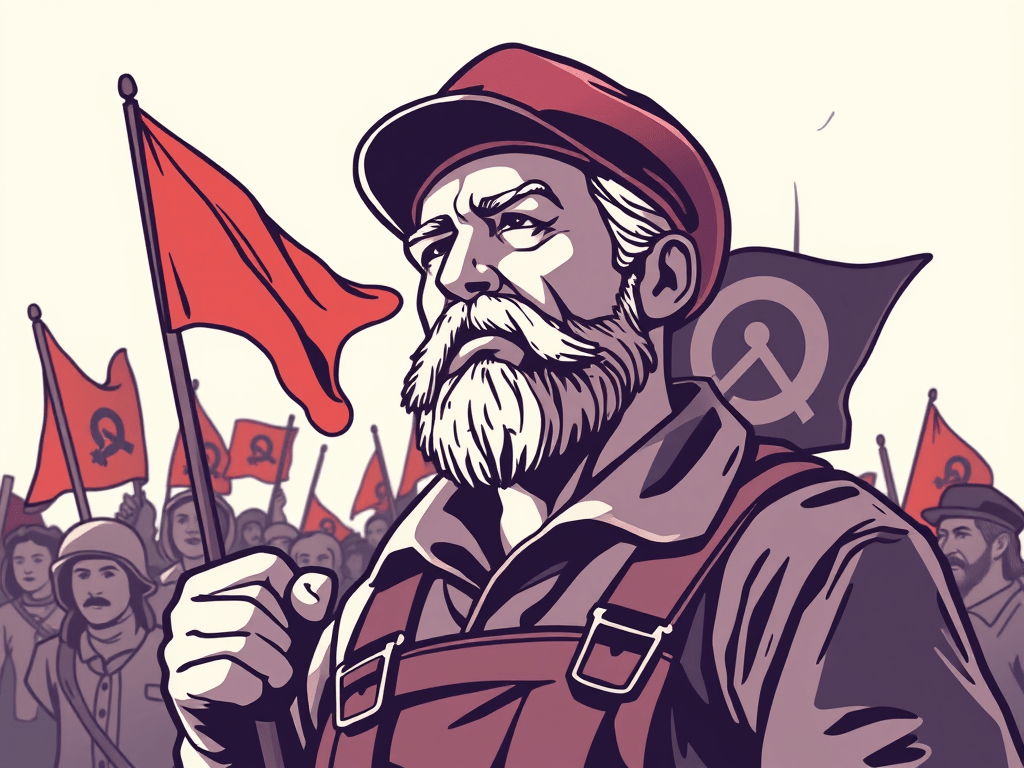
There are few dates on the calendar so freighted with both historical gravity and ideological ambivalence as May Day. For most of the Western world, it has been domesticated into something like an afterthought—perhaps a chance to plant flowers, sip sangria, or in some cases, wave a flag of vague solidarity. But for those who know history not as a collection of anniversaries but as a battlefield of class, blood, and the struggle for human dignity, May Day remains Marxism’s holy day. And like all holy days, it demands not reverence, but scrutiny.
Let us begin, as any good dialectician would, with contradiction. May Day is, on the one hand, a celebration of the worker—of toil, of sweat, of the kind of labor that built cities and topples empires. On the other, it is also a sobering reminder that the working class has been—since the dawn of the industrial age—an object of both worship and exploitation. This duality is not accidental; it is the essence of capitalism, which flatters the laborer only when he stops asking questions.
Marx himself, that bearded prophet of the proletariat, never lived to see May Day institutionalized. The day took shape in 1889, decades after the Communist Manifesto lit its fuse under the foundations of European society. It was the Second International that claimed May 1st in commemoration of the Haymarket affair in Chicago—a workers’ rally turned bloody, and then cynical, as the state executed men more for their ideas than their actions. If there was ever a canonization by martyrdom in the secular church of the left, this was it.
But let us not romanticize too quickly. One of Marxism’s greatest perils is its flirtation with myth-making, its desire to elevate the worker not just as a political agent, but as a redeemer of history. That is a dangerous path—one that leads to the gulag as surely as it leads to the union hall. Orwell saw it, as did Trotsky. The point is not to glorify the worker, but to liberate him—not to raise statues to labor, but to ask why labor is shackled to begin with.
May Day in its Marxist tradition should not be mistaken for some proletarian Christmas. It is not about the joy of work—though the bourgeoisie are always happy to sell that lie. It is about the right not to be enslaved by work. It is about the right to time, to agency, to that most revolutionary of luxuries: leisure. Marx understood this. In the Grundrisse, he wrote that the true realm of freedom begins when labor ends—not in idleness, but in the fullness of human flourishing, uncoerced and undirected by market forces.
And yet, here we are, more than a century later, in a world where May Day is more likely to be observed in Havana than in Hackney, more honored in murals than in legislative chambers. The Western left has, to a dismaying extent, surrendered its revolutionary core for the anesthetics of identity politics and NGO incrementalism. Meanwhile, capital moves faster, extracts deeper, and hides better. The struggle is no less urgent; it is simply less visible. And perhaps more dangerous for being so.
If we are to recover the Marxist meaning of May Day, we must do so not with slogans but with clarity. Marxism at its best was never about dogma; it was about analysis. It was about peering into the entrails of history and naming the forces that shape us. May Day, then, should not be a ritual, but a reckoning. A time to ask: who works, and who profits? Who produces, and who owns? Who labors, and who lives?
And in asking these questions, we might honor Marx not as a saint, but as a thinker. May Day, properly understood, is a summons not to nostalgia, but to confrontation. And in that spirit—if not in literal celebration—it still burns with revolutionary promise.
Let it never be said that the left lacked poetry. But let us also remember that poetry, without politics, is just noise.
Happy May Day!
 Letters from Tomis
Leave a comment