Introduction
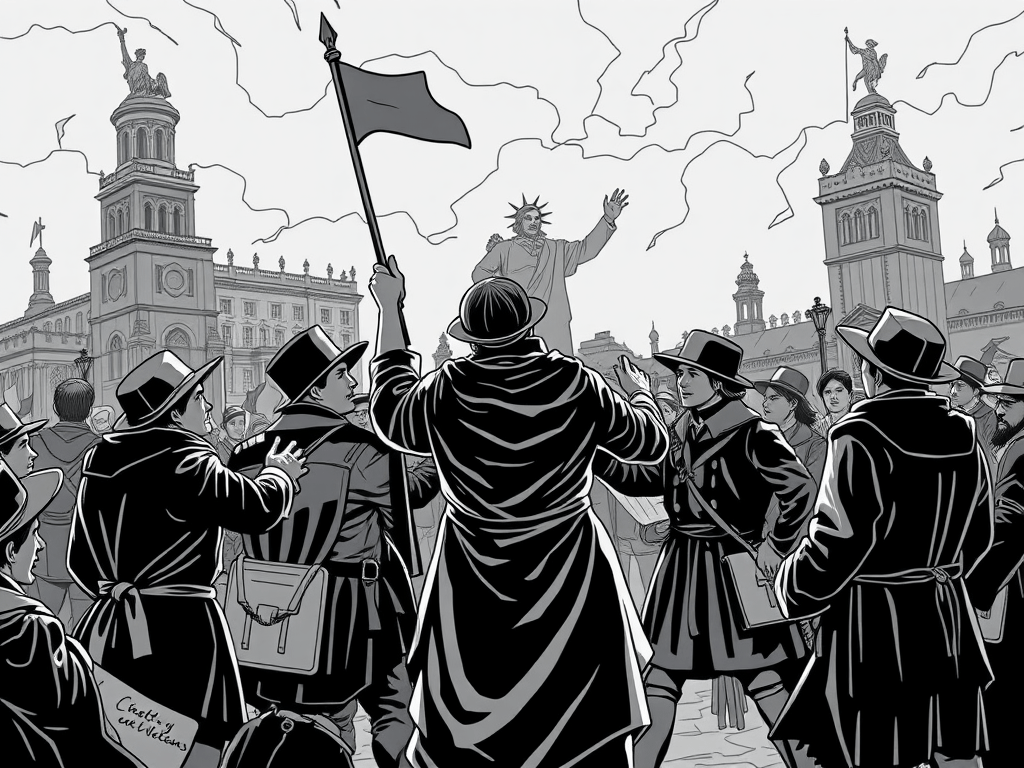
Liberal democracy was once the proud brainchild of the bourgeoisie. In the grand narrative of modern history, the middle-class burghers and merchant elites championed constitutions, parliaments, and bills of rights as tools of their own emancipation. These institutions provided a battering ram against feudal privilege and absolute crowns, empowering the bourgeois class to ascend socially and economically. The bourgeois revolutionaries of the 18th and 19th centuries fought for liberty, property, and the rule of law – not merely out of idealism, but because these ideals conveniently aligned with their class interests. Democracy and liberalism, in other words, were extremely useful to the bourgeoisie’s rise. Yet today we observe a biting irony: having ridden to power on the back of liberal democracy, the bourgeoisie now regards these very institutions with weary exasperation, as if they were relics whose usefulness has been exhausted. The class that once enshrined democratic liberalism appears increasingly willing to dispense with it when it becomes inconvenient.
This essay will argue that democracy and liberalism have begun to outlive their usefulness to the bourgeoisie. I will examine how the bourgeoisie historically leveraged democratic institutions for its own ascension, only to abandon or undermine those institutions when they threatened to level the playing field. From the bourgeois revolutions of the past to the contemporary flirtations with authoritarianism in capitalist democracies, we see a consistent pattern: lofty liberal principles trumpeted in public, quietly betrayed in practice whenever they imperil bourgeois privilege. I will explore historical examples of this betrayal – from 1848 to the 1930s – and then turn to contemporary symptoms of the bourgeoisie’s disaffection with democracy, such as rising authoritarian temptations, the entrenchment of plutocracy, and open disdain for public accountability.
Liberal Democracy: A Tool for Bourgeois Ascension
It has long been a truism that “no bourgeois, no democracy.” Indeed, classical theorists like Barrington Moore once asserted that a robust middle class was the prerequisite for democratic governance. Historically there is much truth to this – the bourgeoisie stood at the forefront of struggles against aristocratic and absolutist rule. As they emerged between the old nobility and the toiling masses, the bourgeois middle classes challenged the entrenched powers of monarchs and feudal lords, fighting for private property rights, free speech, constitutional government, and representative institutions. The great upheavals of the late 18th and 19th centuries – from the American and French Revolutions to the 1848 revolts across Europe – all bore the imprint of bourgeois leadership. In these “great bourgeois revolutions,” merchants, financiers, and industrialists demanded charters and parliaments that would constrain kings and elevate their own influence. Liberal democracy, with its promises of equality before the law and government by consent, was embraced as the supreme political expression of an expanding capitalist order. It was the ideal vehicle for a rising class seeking to displace the old aristocracy and secure a political environment conducive to commerce and industry.
Yet even in this heroic age of bourgeois liberalism, there was always an element of expediency in the class’s commitment to democratic principles. The bourgeoisie’s cry of “liberté, égalité, fraternité” had fine print. Crucially, egalité (equality) was never meant to be absolute; rather, it applied chiefly to their rights versus those of the aristocrats. The dirty little secret of 19th-century liberalism is that the bourgeoisie was often content to restrict suffrage and political power to themselves, excluding large segments of society – minorities, women, and the working poor – from the halls of power. In Britain and France, for example, property qualifications and other barriers ensured that early “democracy” was largely a gentlemen’s club of propertied elites. The universal ideals of liberal democracy were frequently at odds with the bourgeoisie’s particular interests. Nowhere was this more evident than in the colonial sphere: the same Victorian bourgeois liberals who extolled freedom and self-government at home had little compunction about denying those rights to colonized peoples abroad, embracing a racist imperial order utterly contrary to liberal egalitarianism. Hypocrisy, one might say, was baked into bourgeois liberalism from the start – a point not lost on astute observers of the time.
One such observer, the exiled poet Heinrich Heine, noted as early as 1842 that the politics of the middle class were “motivated by fear,” and that bourgeois liberals were all too willing to give up their ideals of liberty to protect their socio-economic position from the lower classes. In the Revolutions of 1848 – that wave of liberal uprisings across Europe – the bourgeoisie initially joined forces with workers and peasants to demand constitutions and rights. But as soon as the specter of too much democracy arose (for instance, the specter of universal male suffrage or, God forbid, socialism), the middle classes panicked. Terrified of “plebeian rage and proletarian political participation,” they rapidly withdrew support from the revolutions they had helped start. From Frankfurt to Paris, liberal revolutionaries made a separate peace with reactionary forces once they realized that political democracy, carried to its logical conclusion, could lead to social and economic democracy. Edvard Beneš, a Czechoslovak statesman reflecting on that history, remarked that the bourgeoisie began to see authoritarian regimes as salvation when faced with the prospect that true democracy might empower the working class at their expense. In short, the bourgeoisie has always been a fair-weather friend to democracy – enthusiastic when representative government could pry power from kings or competitors, but far more hesitant when democracy threatened to pry power from the bourgeoisie itself.
The Bourgeoisie’s Illiberal Turn: From Champion to Skeptic
By the early 20th century, this conditional loyalty to democracy became starkly clear. The bourgeoisie’s relationship with liberal democracy had turned from warm embrace to cold pragmatism – even outright betrayal – whenever their privileges felt imperiled. The most extreme historical example was the interwar period (1920s–30s), when large sections of the bourgeoisie across Europe made an ill-fated flirtation with fascism. Terrified by the rising specter of communism and mass worker movements in the wake of World War I, the middle and upper classes in many countries flocked to right-wing strongmen, showing precious little commitment to the liberal democratic values they once trumpeted. Autocrats like Mussolini, Franco, and Hitler were seen by much of the propertied class as bulwarks against socialist revolution – a strong medicine to protect their wealth and status in a time of crisis The “fervour of nationalism, militarism and racism” that gripped the European bourgeoisie on the eve of World War II was no accident. It was, in part, the result of a calculated choice: better to back authoritarian rule that safeguarded private property than to risk a fully empowered democratic populace that might vote to redistribute wealth or upend the social order.
The words of Hitler’s notorious legal philosopher, Carl Schmitt, resonated with many bourgeois in those days: only a strong authoritarian state could guarantee the preservation of the propertied middle class. And so it went. Parliaments were dissolved, constitutions suspended, and once-vocal champions of liberalism fell disturbingly silent. Industrial tycoons and financiers bankrolled fascist parties; conservative politicians welcomed dictators as preferable to elected leftists. This collapse of bourgeois democracy was noted by contemporaries with alarm. Writing in 1941 as the Axis powers seemed on the verge of extinguishing democracy in Europe, the commentator George Stern observed that “bourgeois democracy was the supreme political expression of an expanding capitalist order. With the decline of capitalism it became an intolerable overhead charge for the reactionary bourgeoisie.” In other words, when economic crisis struck and capitalism’s forward momentum stalled, the costs and inconveniences of democracy (free elections, free speech, labor rights, etc.) became an “overhead” the bourgeoisie no longer wished to bear. At that point, many among the elite were quite content to jettison democratic norms in favor of strongman rule – a grim precedent that haunts us still.
The pattern was repeated outside Europe as well. During the Cold War, bourgeois and middle-class constituencies in many regions continued to embrace authoritarian measures whenever it suited their interests. In the United States and Western Europe, a hard line against communists – including limitations on freedom of speech and association for left-wing dissidents – was broadly tolerated, even by otherwise liberal middle-class citizens. The logic remained the same: if “freedom” for some endangered the property or security of the bourgeois order, then freedom could be curtailed. Likewise, across much of Latin America, Asia, and the Middle East in the 20th century, rising middle classes often prospered under authoritarian regimes and supported political repression, so long as these regimes delivered stability and guarded against radical change. Whether it was the military juntas in Brazil and Chile (backed by business interests against socialist presidents), or the one-party developmental states in East Asia that created comfortable conditions for a new bourgeoisie, the story was similar. Far from uniformly demanding democracy, bourgeois forces frequently preferred dictatorship if democracy seemed to empower the “wrong” people. As one analyst dryly concluded, “Middle classes are not a priori engines of political liberalisation. They can readily become the promoters of repressive authoritarianism if they fear for the loss of influence and wealth.” The bourgeoisie, Janus-faced as ever, could one day publish eloquent homilies to liberty – and the next day applaud a coup d’état, if their “sacred values” of property and profit were at stake. To borrow a line from Trotsky’s Manifesto of the Fourth International (1940), “the bourgeoisie never defends the fatherland for the sake of the fatherland…They defend private property, privileges, profits. Whenever these sacred values are threatened, the bourgeoisie immediately takes the road of defeatism.” In our context, we might adapt that: the bourgeoisie never defends democracy for the sake of democracy; it defends democracy only so long as it defends their privileges.
Contemporary Symptoms of Bourgeois Disdain
History, alas, does not repeat in exactly the same form, but it certainly rhymes. In our present era of globalized capitalism and yawning inequality, one can detect a palpable shift in bourgeois attitudes toward liberal democracy. The outward forms of democracy remain – elections are held, parliaments convene – but the spirit has curdled. There is a sense that many of today’s economic elites quietly view liberal democratic institutions as obsolete obstacles, cumbersome speed bumps on the road to greater wealth and control. Let us consider a few of the contemporary symptoms of this shift:
Flirting with Authoritarianism
In several capitalist democracies, segments of the bourgeoisie have shown an alarming tolerance for authoritarian rhetoric and tactics. They may not be marching in brownshirt parades, but their money and influence often prop up illiberal movements. From Hungary’s Viktor Orbán to the ruling Law and Justice party in Poland, right-wing populists who chip away at democratic checks and balances have enjoyed the patronage or acquiescence of business elites. Not coincidentally, Orbán has cultivated a clique of friendly oligarchs, and his “illiberal revolution” in Hungary has weakened the independence of courts and media while enriching connected businessmen . In the United States, one need only follow the money to see elite fingerprints on democratic backsliding: billionaire donor networks have funded campaigns to gerrymander districts, suppress voter turnout, and flood elections with unlimited money – effectively undermining majority rule when it threatens their preferred policies. Political scientists note that authoritarian capitalism – the model of regimes like China or Singapore, which embrace markets but reject liberal rights – holds a technocratic appeal for some Western business leaders weary of the chaos of democratic debate. The fact that authoritarian regimes often have substantial business support suggests that democracy itself rests on a shaky foundation of elite consent: if profits are safer under a strongman, many capitalists seem quite willing to make that bargain. In short, democracy has no shortage of fair-weather friends in high places today. We see corporate lobbyists and wealthy patrons cozying up to politicians with openly authoritarian tendencies, so long as their investments and interests are secure. It is an echo of the 1930s, albeit in bespoke suits rather than jackboots – a flirtation with illiberalism couched in the language of “stability” and “law and order.”
Plutocratic Entrenchment
Another symptom is the entrenchment of plutocracy under the guise of democracy. In theory, democracy implies political equality – one person, one vote. In practice, however, wealthy elites have an outsized influence on policy and governance, to the point that some scholars argue we are living in a “post-democracy” where elections occur but power has shifted to unelected elites. Colin Crouch coined the term post-democracy to describe how, since the late 20th century, formal democratic institutions continued to operate, yet real decision-making increasingly moved into the hands of corporations and financial moguls. He observed that political parties, once mass movements representing broad memberships, have degenerated into organizations controlled by financial elites . In today’s capitalist democracies, this is hard to deny. Billionaire donors set the agenda of major political parties; media corporations owned by tycoons shape public opinion to align with their interests; and policies that inconvenience the rich – be it stringent financial regulation or higher taxes on wealth – face seemingly insurmountable headwinds in legislatures. Empirical research in the United States has laid bare this reality. A famous Princeton-Northwestern study in 2014 found that economic elites and organized business groups have substantial influence on government policy, while average citizens have virtually none. When the preferences of the affluent diverge from those of the majority, it is the affluent who almost always get their way. Democracy, in effect, has been quietly reconfigured into a comfortable plutocracy, in which elections become expensive performances – what Lenin once acidly described as “spectacular and meaningless duels between two bourgeois parties” run by multimillionaires. The forms of liberal democracy remain, but the content is empty for anyone outside the charmed circle of wealth. Christopher Hitchens often inveighed against such oligarchic tendencies, having no patience for the idea that a “free market” automatically yields a free society. Indeed, today liberal democracy appears to be evolving (or devolving) into a system where the few rule in the name of the many – precisely the outcome the bourgeoisie is comfortable with, so long as they are the few in charge.
Disdain for Public Accountability
Perhaps the most telltale symptom of all is the barely concealed disdain that many elites show for public accountability and the common citizen. One hears it in the tone of certain billionaire CEOs who dismiss critics as ignorant masses, or in the scorn of hedge-fund magnates for government regulators. As the Koch network and other ultra-wealthy interest groups have strategized, their aim is often to “make our democracy less responsive to the majority of people,” undercutting collective power whenever it challenges their agenda. In private, some of these magnates “just have a deep disdain for the broader public and for people’s use of collective power.” They envision society as a hierarchy of “makers” and “takers,” celebrating corporate titans and scorning the rest. Is it any surprise, then, that mechanisms of public accountability are being eroded? Watch closely and you’ll see how the wealthy and powerful increasingly operate behind closed doors and opaque institutions, insulating themselves from the democratic oversight that might curb their ambitions. Public services are privatized, placing them in the hands of corporate actors not answerable to voters. As more aspects of life – from prisons to water supplies – are run for profit, citizens are converted from stakeholders to mere customers, and accountability vanishes in a fog of executive decisions. Scholars note that this “commercialisation of welfare” and outsourcing of state functions leads to “a more centralised democracy and state — and to less accountability.” In other words, by shrinking the public sphere, elites can avoid the nuisance of answering to the people. Even within government, elite disdain for accountability manifests in the weakening of checks and balances. Independent judiciaries and watchdog agencies are undermined under the pretext of efficiency or cost-cutting. Freedom of Information laws are narrowed; whistleblowers are persecuted. And of course, there is the outright hostility to a free press, the traditional safeguard against tyranny. Increasingly, sections of the bourgeoisie seem to regard a truly free media (one that might expose their misdeeds or rally public outrage) as an inconvenience to be managed or co-opted. Instead, they prefer tame media empires – often owned by fellow billionaires – that toe the line. In France, for instance, a “powerful network of media controlled by conservative billionaires” has been accused of enabling undemocratic decisions to proceed with little scrutiny. All these trends point to one conclusion: the current bourgeois elite are tired of being scrutinized by the public and are systematically removing the forums and tools that make them answerable to society. Liberal democracy’s culture of accountability – elections, a free press, civic activism, transparent governance – is precisely what they now find “intolerable”, to borrow George Stern’s word, much as their forebears did when faced with mass democracy in the 1930s.
Conclusion: The Ironic Sunset of Liberal Democracy
It is a truism that every revolution devours its children. In the case of the bourgeois revolution, we might say it is devouring its parents. The liberal democratic order that the bourgeoisie midwifed into existence is now being quietly smothered by that very same class. Of course, the obituary of democracy is not yet written – popular resistance and the sheer inertia of institutions still stand in the way of a full-blown oligarchic takeover in many countries. But the trajectory is unmistakable. The bourgeoisie have learned that their dominance no longer requires the bright sunshine of genuine democracy; they can thrive just as well in the half-light of managed pseudo-democracies or even in the dark of authoritarian capitalism. As Hitchens might observe with a sardonic grin, the Platonic façade of the “Liberal Democratic Order” is cracking, revealing the less ennobling reality behind: a society where all are equal, but some are far more equal than others.
Historically, the bourgeoisie used democracy as a ladder to climb to power. Now perched at the top, they see little use in holding the ladder steady for the rest of society – indeed, they are more inclined to kick it away. The rising flirtations with authoritarianism, the solidification of plutocracy, and the contempt for public accountability are all contemporary signs that the bourgeoisie’s marriage of convenience with liberal democracy is heading for a divorce. In the end, this class was never in it for the principle of popular rule or universal rights; it was in it for the profit and power that liberal democracy, at one stage, enabled them to seize. Now that those same principles arm the public to question gross inequality and demand fairness, the bourgeoisie grows impatient with them. One is reminded of an old admonition against “entrusting the henhouse to the fox.” Democracy entrusted to the bourgeoisie has ultimately meant democracy at the mercy of the bourgeoisie’s needs – and when democracy no longer serves those needs, it is throttled.
I marvel at the cynicism on display. We have seen this play before, and we know how it ends when the moneyed elite decides it has had enough of the people’s rule. I excoriate the complacency of those who still think liberal democracy’s triumph is assured simply because it prevailed in history. Democracy, has disappeared in the past. It would be silly to assume it cannot disappear again, especially if it’s supposed beneficiaries decide they prefer a different arrangement. And so, with a mix of irony and urgency, I conclude: democracy and liberalism, once the cherished darlings of the bourgeoisie, are now being treated as expendable – their usefulness exhausted, their inconveniences accumulating. The bourgeoisie has gotten what it wanted from them. What remains to be seen is whether the rest of us – the demos that democracy supposedly empowers – will let this historic reversal occur without a fight. Liberal democracy may have been a “bourgeois compromise”, but its erosion will have profound consequences for everyone else caught beneath the weight of a self-serving elite. In exposing this reality, one hopes to “hold a mirror up to those in power” and remind them (and us) that the price of abandoning democracy may ultimately be higher than even the bourgeoisie can afford.
 Letters from Tomis
Leave a comment