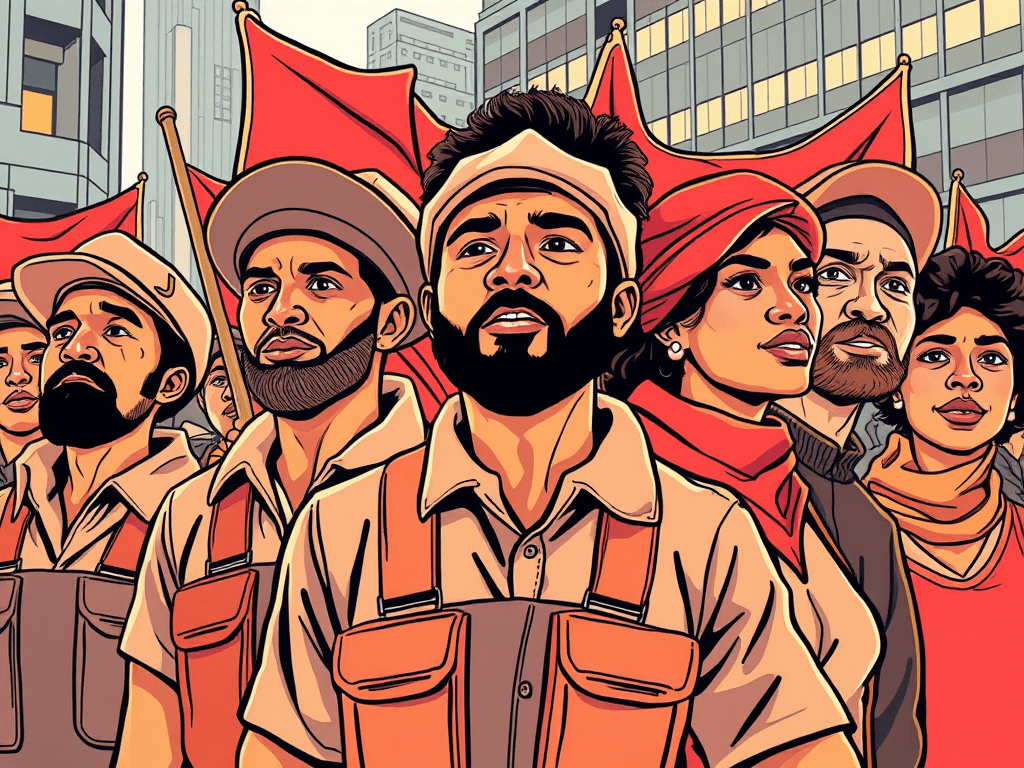
If there is a single idea within Marxist thought that remains both inexhaustibly relevant and perpetually misunderstood, it is the relationship between class consciousness and revolutionary violence. To the uninformed, Marxism is often caricatured as little more than a doctrine of brute force, a kind of grand guillotine philosophy wherein the only solution to economic inequality is the eager execution of landlords and bankers. This is, at best, a crude simplification and, at worst, a deliberate distortion. The truth is far more nuanced and, to those who genuinely care about justice, far more hopeful.
For Marx, the key to historical progress lies not in violence for its own sake but in the development of class consciousness—the moment when the proletariat, that great and long-exploited majority, realizes its true collective power. The material conditions of capitalism, with its tendency to concentrate wealth and alienate labor, inevitably push the working class toward an awareness of its oppression. This process is not an academic exercise but an unavoidable awakening, as necessary and predictable as gravity.
What follows from this consciousness, however, is not the immediate call for indiscriminate violence. The revolution Marx envisioned was not a nihilistic bloodbath but a rational, organized reconfiguration of society. In the Communist Manifesto, Marx and Engels explicitly frame the struggle as a matter of class solidarity, not mindless destruction. “The proletarians have nothing to lose but their chains,” they write—not their humanity, not their ethics, not their ability to build a better world.
Now, one does not need to be naïve about the course of history to recognize that force has played a role in every significant political upheaval. The American and French revolutions, both of which are celebrated in liberal democratic mythology, were achieved through violence and insurrection. It would be the height of hypocrisy to demand that the working class alone submit to pacifism while every other ruling order in history has been forged and defended by force. Yet to suggest that Marxism is defined by violence rather than class consciousness is to misunderstand its essence entirely.
Indeed, history shows that the most successful Marxist movements have been those that prioritized the organization and education of the proletariat over the blind application of force. The early labor movements, the struggles for the eight-hour workday, the victories of trade unions—these were battles won not by the guillotine but by the disciplined, collective assertion of workers’ rights. The most dangerous enemy of capitalism has never been the revolutionary with a rifle but the worker who understands that his labor creates all value, that his exploitation is neither natural nor inevitable, and that he is not alone.
Marx himself understood that violence, when it occurs, is not a matter of ideology but of necessity. A ruling class does not simply step aside because its time has come; history is replete with examples of elites who, when confronted with their own obsolescence, choose repression over reform. In such cases, resistance is not merely justified but inevitable. But the real power of Marxism, and the reason it continues to haunt the dreams of capitalists long after its supposed demise, is not its capacity for destruction but its vision for construction.
A truly Marxist revolution is not an orgy of violence—it is a reassertion of human dignity. It is the moment when the workers of the world, long pitted against one another by artificial national and racial divisions, recognize their shared struggle and act accordingly. It is the end of a system that treats human beings as mere commodities and the beginning of a society that values labor as the source of all wealth.
This is why Marxism remains a living, breathing force, and why, despite the endless attempts to bury it, it continues to rise. It is not a doctrine of death but of life—a call for people to wake up, to see the world as it is, and to take it back for themselves. Violence may be a part of that process, but it is not the essence of the struggle. The true revolution, as Marx understood, begins not with the gun, but with the mind.
 Letters from Tomis
Leave a comment