An ongoing series of reflections on Marxist economics after reading What is Marxism: An Introduction into Marxist Theory by Rob Sewell and Alan Woods. The thoughts, opinions, and any errors are mine alone.
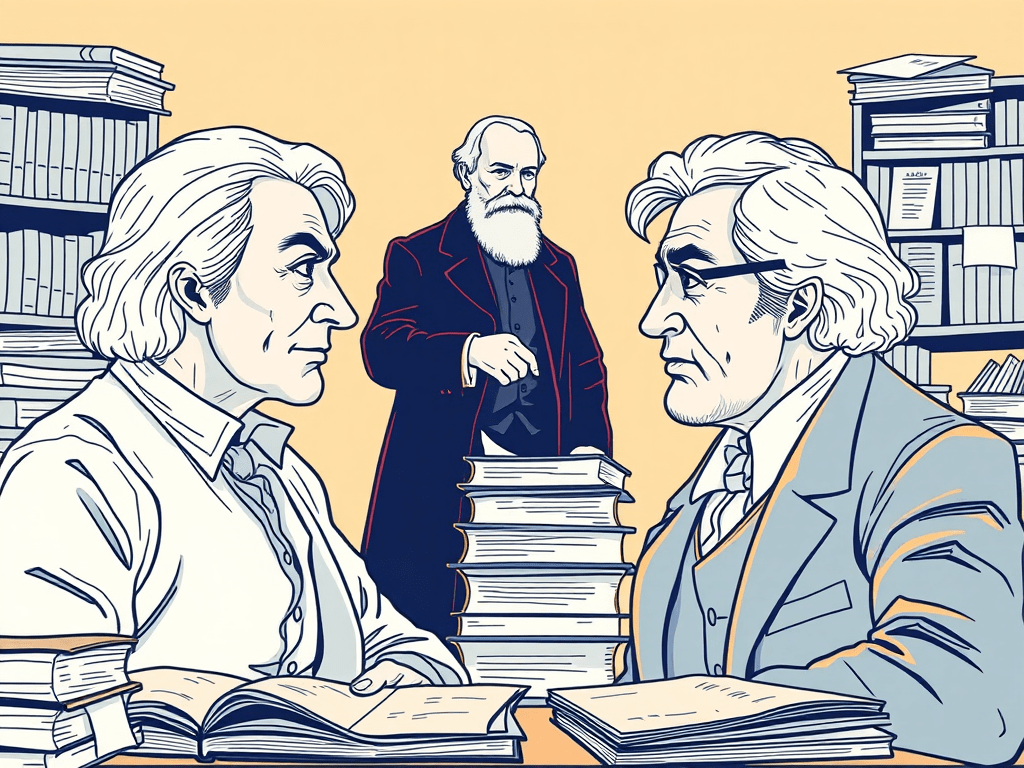
The notion that labor is the source of value is among the most enduring, contentious, and revolutionary insights in the history of political economy. It was an idea with deep classical roots, but one that found its most sophisticated and radical expression in the work of Karl Marx. To appreciate Marx’s development of the labor theory of value, we must first take a measured look at his intellectual forebears, namely Adam Smith and David Ricardo. These thinkers, despite their ideological differences, laid the groundwork for Marx’s critique of capitalism, and in doing so, unwittingly handed him the very tools with which he would attempt to dismantle their world.
The Labor Theory of Value: Smith and Ricardo
Adam Smith, the philosophical father of capitalism, is often associated with the free market, the invisible hand, and the rise of industrial wealth. Yet, in The Wealth of Nations, he put forward an early version of the labor theory of value. He argued that in primitive societies, before the emergence of capitalist relations, commodities exchanged in proportion to the labor required to produce them. In other words, a hunter who took twice as long to kill a deer as a fisherman took to catch a fish would expect to trade one deer for two fish. Labor, for Smith, was the “original purchase price” of all goods.
However, Smith recognized that as societies developed, landowners and capitalists extracted wealth from workers through rent and profit. He attempted to reconcile this by asserting that in more advanced economies, value was divided among wages, profit, and rent. Though Smith acknowledged that labor was the original source of value, he ultimately obscured the labor theory by allowing for these additional claims on production.
David Ricardo, writing in the early 19th century, refined Smith’s labor theory with mathematical precision. In his Principles of Political Economy and Taxation, he argued that the value of commodities was determined by the total amount of labor necessary for their production, including the labor required to produce tools and raw materials. Crucially, Ricardo also identified a fundamental contradiction within capitalism: as profits increased, wages tended to stagnate, and vice versa. Though he remained within the framework of bourgeois economics, he laid bare the inherent conflict between labor and capital.
Marx and the Transformation of the Labor Theory
Karl Marx took the insights of Smith and Ricardo and, with the force of dialectical materialism, turned them against the system they sought to explain. In Capital, he did not merely refine the labor theory of value—he revolutionized it.
For Marx, labor was not just a source of value; it was the sole source of value. He argued that the capitalist mode of production operated on a fundamental theft: the extraction of surplus value. Workers, he contended, were paid wages based not on the full value of what they produced, but merely on the cost necessary to sustain their labor-power (the means of subsistence required for them to continue working). The difference between what workers produced and what they were paid was surplus value, which was pocketed by the capitalist as profit.
This was the mechanism of exploitation. Unlike Smith and Ricardo, who saw profit as a necessary return to capital, Marx exposed it as a direct result of unpaid labor. In this analysis, the capitalists were not merely industrious entrepreneurs but economic parasites, living off the stolen labor of the working class.
Marx also introduced the concept of commodity fetishism, a searing critique of how capitalist societies obscure the true nature of value creation. In a capitalist economy, commodities appear to have an inherent value, as if independent of the labor that created them. This, Marx argued, was a form of mystification that allowed capitalism to perpetuate itself—workers were alienated from the fruits of their labor, and society was blind to the fundamental role of labor in value creation.
The Historical Significance of Marx’s Contribution
Marx’s labor theory of value was not merely an economic argument; it was a weapon of revolutionary critique. While Smith and Ricardo sought to understand the workings of a capitalist economy, Marx sought to expose its contradictions and predict its demise. His analysis of surplus value provided the theoretical foundation for socialist movements, inspiring generations of revolutionaries and reformers.
Though mainstream economics has unfortunately largely abandoned the labor theory of value in favor of marginalist and subjective theories, its relevance endures. The growing inequality of modern capitalism, the precarious conditions of labor in the gig economy, and the resurgence of socialist ideas all speak to the power of Marx’s insights. Even today, as capital extracts ever more surplus from an increasingly disposable workforce, his theory remains a vital tool for understanding the structural forces of exploitation.
Conclusion
Marx did not invent the labor theory of value; he inherited it, sharpened it, and wielded it against the very system that had nurtured its earlier proponents. Smith and Ricardo, for all their contributions, stopped short of recognizing the full implications of their own theories. Marx had no such hesitation. He tore the veil from the economic system, exposing it not as a natural order but as a historical construct built on exploitation. Whether one accepts or rejects his conclusions, there is no denying that his refinement of the labor theory of value remains one of the most powerful intellectual achievements in history.
 Letters from Tomis
Leave a comment