An ongoing series of reflections on Marxist economics after reading What is Marxism: An Introduction into Marxist Theory by Rob Sewell and Alan Woods. The thoughts, opinions, and any errors are mine alone.
If one wishes to understand the economic vulgarities of our time—where a Wall Street speculator can earn in an hour what a nurse makes in a year, or where a CEO can see his net worth multiply simply by laying off the very workers who produce his company’s goods—then one must begin with Karl Marx’s most incendiary and illuminating insight: the Labor Theory of Value.
Dismissed by the priesthood of modern economics as an anachronistic relic, this theory is in fact an indispensable scalpel, cutting through the obfuscations of supply-and-demand mysticism, the cult of the entrepreneur, and the delusions of financial alchemy. It reminds us of something so simple and so manifestly true that only the most sophisticated sophists could deny it: all economic value is, at its root, created by human labor.
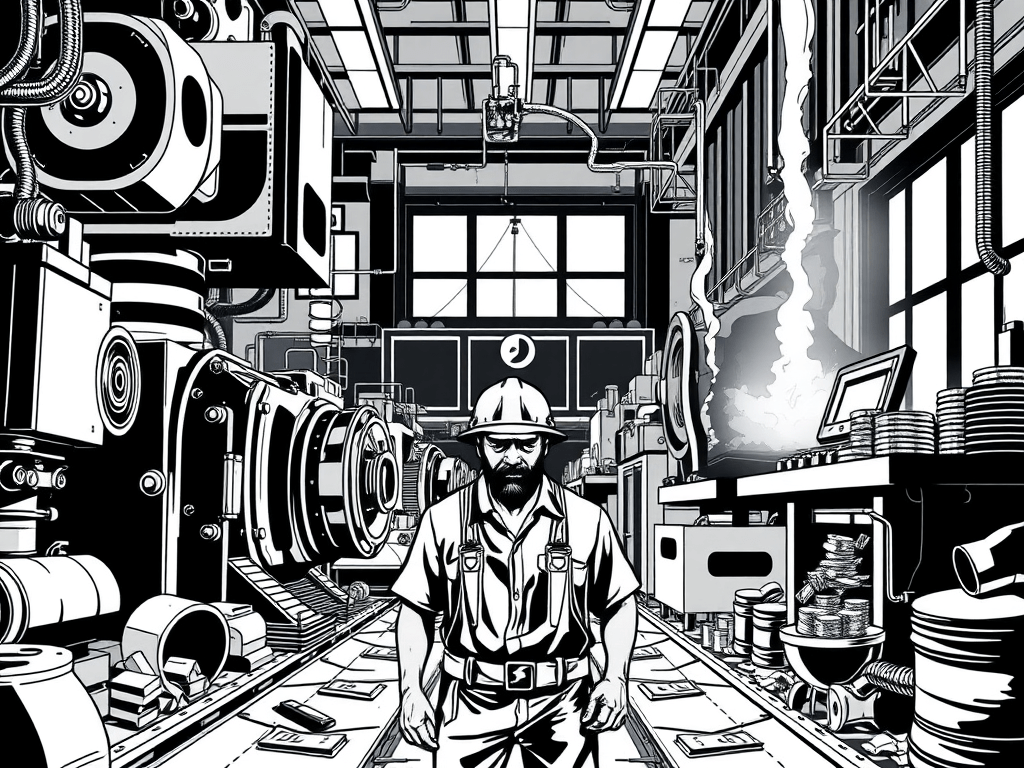
Marx, building upon the classical economists Adam Smith and David Ricardo, did not merely claim that labor contributes to value—an assertion so obvious as to be banal. He argued, rather, that labor is value, that the wealth extracted and hoarded by the ruling classes is in every case the crystallized effort of workers who, though indispensable, are denied their due. A factory without workers is merely a warehouse of inert machinery. A farm without farmers is nothing more than an overgrown field. A restaurant without cooks and servers is simply a room full of empty tables. And yet, under capitalism, it is not the worker who reaps the full benefit of production, but the owner, the shareholder, the well-groomed and well-remunerated parasites who contribute nothing but reap everything.
This, of course, is where the defenders of capital leap in with all the zeal of a medieval inquisitor. “Ah, but what of capital itself? What of the entrepreneurial genius who organizes labor and risk? What of the investor whose prudent allocation of resources allows business to thrive?” These protestations have the same ring as a theology student scrambling to explain how an omnipotent god can coexist with the existence of suffering—earnest, verbose, but utterly unconvincing.
The so-called risk-taking investor does not toil in the fields, does not sweat in the mines, does not bend over an assembly line, does not nurse the sick, does not teach the children, does not build the homes, does not pave the roads. He simply moves money around, like a gambler shifting chips at a casino, and then collects the winnings while workers are left to live on wages that barely cover rent. The system does not reward labor, it rewards ownership. It does not compensate production, it compensates possession. And to disguise this vulgar injustice, capitalism has had to manufacture a pseudo-science—modern economics—that functions in much the same way as astrology: by giving an air of empirical legitimacy to the naked machinations of power.
One need only look at the obscene stratifications of wealth in our own era to see the truth of the Labor Theory of Value made manifest. Consider the unholy empire of Amazon, where Jeff Bezos—patron saint of late-stage capitalism—has amassed a fortune so vast that he could personally end world hunger and finance the colonization of Mars, while his workers piss in bottles to meet delivery quotas. If labor were not the true source of value, then why must it be so ruthlessly extracted, surveilled, and exploited to maintain the fortunes of billionaires? If capital alone could generate wealth, why do the owners of industry rely on an army of exhausted, underpaid laborers rather than simply watching their capital multiply on its own?
The critics of Marx scoff at the LTV as an outdated model, an abstraction unsuited to our “modern” and “complex” economy. But one is forced to ask: complex for whom? It is complex for those who wish to obscure the truth. It is complex for those who find it inconvenient to admit that the entire capitalist edifice is a monument built upon unpaid labor, upon stolen time, upon the systematic transfer of wealth from those who produce to those who control. The greatest trick capitalism ever pulled was convincing people that value is determined by the whims of the market rather than by the exertions of workers.
A century and a half after Marx, the fundamental truths of the Labor Theory of Value remain unshaken. The only question is whether we are willing to acknowledge them, to strip away the veils of ideology and recognize that every skyscraper, every technological breakthrough, every loaf of bread, every surgical procedure, every work of art—all of it—is the product of labor, and labor alone. And if we recognize that, then we must also recognize something even more radical: that a world in which those who labor are denied the fruits of their own work is not merely inefficient or misguided, but obscene, immoral, and worthy of nothing less than total and unapologetic revolution.
 Letters from Tomis
Leave a comment