An ongoing series of reflections on Marxist economics after reading What is Marxism: An Introduction into Marxist Theory by Rob Sewell and Alan Woods. The thoughts, opinions, and any errors are mine alone.
A commodity, in Marxist economics, is not merely a thing, nor simply a good to be bought and sold. It is an artifact of human labor imbued with an economic soul—a unit of exchange whose existence is dictated by the insatiable logic of the market. It is, in short, an object estranged from its creator and thrust into a realm where its worth is measured not by its inherent utility but by its capacity to be sold.
Karl Marx, with his keen dialectical scalpel, dissected the commodity into two fundamental components: use-value and exchange-value. The former is self-evident—an item’s practical function, the reason it is made in the first place. A loaf of bread feeds the hungry, a coat shields one from the cold, and a hammer drives a nail. Yet under capitalism, these simple truths are subordinated to the merciless arithmetic of exchange-value, which determines an object’s worth not by its practical benefits but by how much it can fetch on the market.
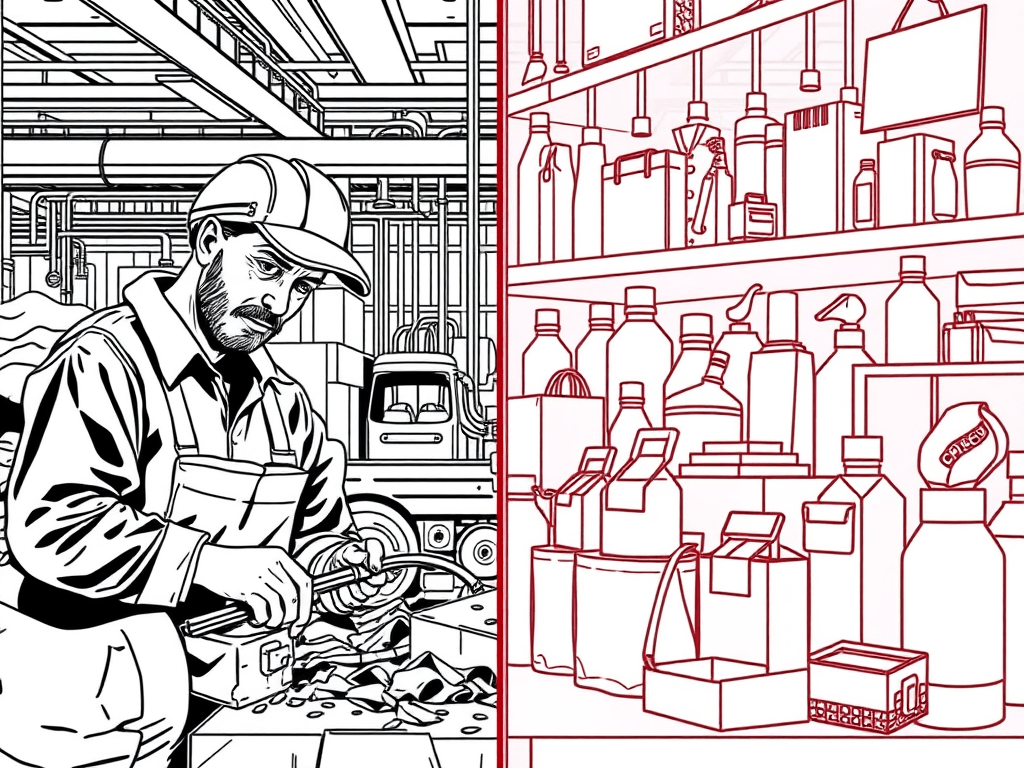
This distinction, however, is not mere academic nitpicking. It is the very foundation of the alienation that defines capitalist society. The worker who bakes the bread does not eat it; the seamstress who stitches the coat does not wear it; the carpenter who crafts the hammer does not wield it. Instead, these items become commodities, detached from those who produced them and made to dance to the tune of market forces. This is the defining tragedy of modern labor: the producer is separated from the product, the laborer from the fruits of labor.
The Commodity Fetish: Worshipping the False Gods of Capital
Here enters one of Marx’s most astute observations—his notion of commodity fetishism. In a society ruled by the market, commodities take on a mystical quality, as though they possess intrinsic value independent of the human effort behind them. The finished product appears before us, neatly packaged, tagged with a price, its origins obscured. We do not see the sweat of the factory worker in the glow of our smartphones, nor do we hear the clatter of distant sewing machines in the fine stitch of our designer suits. Instead, commodities present themselves as objects of inherent worth, as though they possess power in and of themselves.
This illusion—this fetishism—is the ideological sleight of hand upon which capitalism depends. It allows for the subjugation of workers by making the labor process invisible. A factory in Bangladesh collapses, killing hundreds, yet the garments it produced still hang in department stores, untainted by the suffering that bore them. The commodity erases its history, and in doing so, it erases the worker.
The Social Relations Behind the Commodity
If commodities were merely things, their existence would be trivial. But they are not. They are social relations disguised as objects. When we buy a product, we do not merely engage in an exchange of goods; we participate in an economic structure that dictates who labors, who profits, and who is exploited. The price of a commodity is not simply a reflection of its material worth but of the wages suppressed, the surplus extracted, and the capital accumulated.
Consider, for instance, the paradox of value that so perplexed classical economists. Why is water, essential for life, often cheaper than diamonds, which serve no real function beyond ornamentation? Marx resolved this conundrum by demonstrating that value is not derived from an object’s utility but from the socially necessary labor time required for its production. Diamonds are costly not because they are intrinsically valuable, but because their extraction and refinement demand greater labor and machinery investment. In contrast, water—despite being indispensable—remains inexpensive because its procurement, in most cases, demands less labor.
Thus, in the cold calculus of capital, an object’s worth is dictated not by human need but by the amount of socially necessary labor time expended upon it. The result? A world in which luxury thrives while necessity languishes—a world where yachts are plentiful, but clean drinking water remains scarce for millions.
The Commodification of Everything
The true horror of the commodity, however, is not confined to physical goods. Under capitalism’s relentless expansion, everything—human labor, nature, even human emotion—becomes a commodity. Education is no longer the pursuit of knowledge but a product to be sold; healthcare is not a right but a service contingent upon one’s ability to pay; even art, once a sacred refuge from market forces, is now a battleground of speculation, where paintings are hoarded as investments rather than appreciated as works of beauty.
And what of the human being himself? Under capitalism, he too is reduced to a commodity, his labor bought and sold like any other product. He is not a person but labor-power, a unit of production whose existence is determined by his ability to generate surplus value for his employer. The worker sells his time, his energy, his very life-force, in exchange for a wage that is always less than the value he produces. This, for Marx, is the great swindle of capitalism: the worker’s labor creates wealth, yet he sees only a fraction of its rewards, while the capitalist, who owns the means of production, pockets the difference.
Conclusion: Beyond the Commodity Form
If there is one lesson to be drawn from Marx’s analysis of the commodity, it is that capitalism is not a neutral system of trade but a structure of power—a machine designed to extract labor from the many for the enrichment of the few. The commodity is not just an object; it is the physical manifestation of this exploitation, the product of human effort severed from its creator and repurposed for profit.
To live under capitalism is to live in a world where everything is for sale, where nothing exists beyond its potential for exchange. It is a system that turns human relationships into transactions, turns nature into raw material, and turns life itself into something to be bought and sold.
But as history has shown, no system, however entrenched, is eternal. The commodity form is not a law of nature but a product of historical conditions. And as it was created, so too can it be dismantled. The question, then, is not whether we can imagine a world beyond commodities—it is whether we have the courage to build one.
 Letters from Tomis
Leave a comment