An ongoing series of reflections of my thoughts on historical materialism after reading What is Marxism: An Introduction into Marxist Theory by Rob Sewell and Alan Woods. The thoughts, opinions, and any errors are mine alone.
To speak of the “Dark Ages” is to evoke a period shrouded in a certain cultural mythology. The term conjures images of intellectual stagnation, crumbling empires, and a Europe plunged into chaos, awaiting the renaissance of reason. Yet, to view this era solely as an abyss in human progress is both simplistic and historically lazy. A more nuanced understanding can be gleaned through the lens of historical materialism—a method that unveils the economic and material conditions that underpinned the transformations of this period.
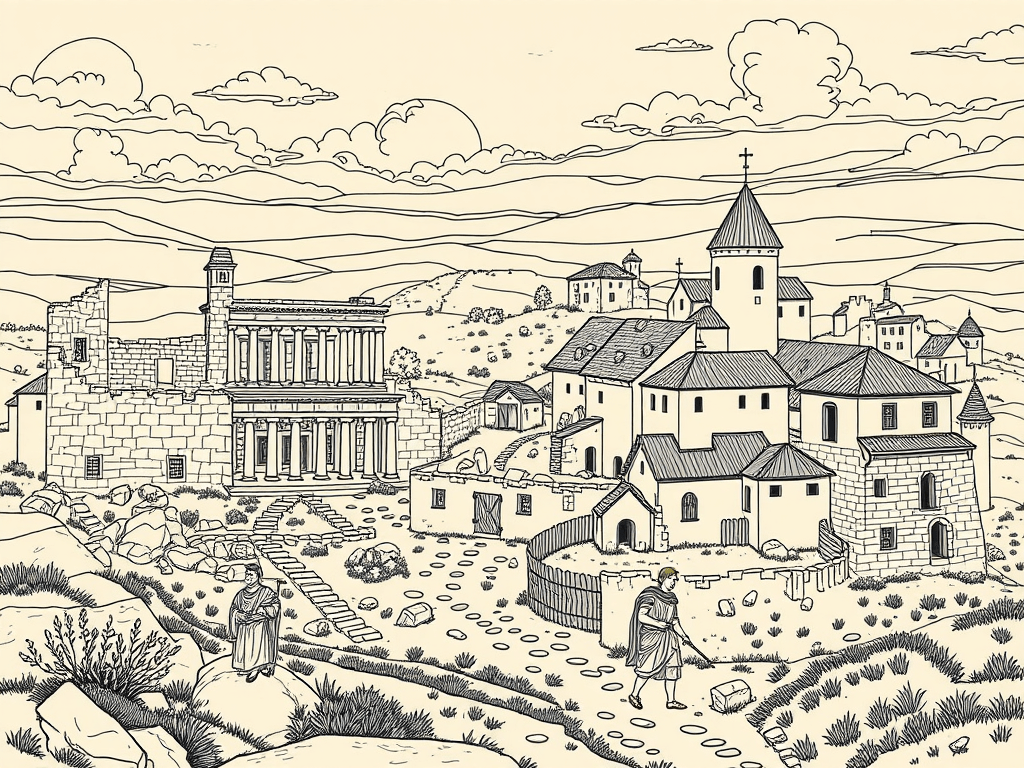
Far from being an accident of history or a simple retreat from the light of Roman civilization, the so-called Dark Ages were the product of a profound restructuring of the economic base and social relations. The decline of Rome, the fragmentation of its empire, and the emergence of feudal society were all expressions of material contradictions inherent in the Roman system itself.
The Fall of Rome: Economic Contradictions in an Empire
The Roman Empire, often idealized as a bastion of culture and order, was built upon an economic foundation riddled with contradictions. Its economy was predominantly agrarian, reliant on slave labor and territorial expansion. As long as Rome could conquer new lands and extract resources, the system sustained itself. But what happens when expansion ceases? What happens when the cost of maintaining far-flung provinces outweighs the wealth they produce?
By the 4th and 5th centuries, the Roman economy was overextended. Slavery, the backbone of Roman production, began to falter as territorial conquests diminished and the supply of enslaved laborers dwindled. Without the steady influx of new slaves, agricultural output declined, and economic stagnation set in. This was compounded by internal corruption, overtaxation, and the depletion of soil fertility in key regions. The economic engine that had powered the empire sputtered to a halt, leaving its social and political superstructure vulnerable.
Enter the so-called barbarian invasions—a convenient scapegoat for Rome’s collapse. Yet, these incursions were less a cause than a symptom. The tribes that swept into Roman territory were not so much destroying an empire as inheriting the wreckage of one that had already eroded under its own contradictions.
The Transition to Feudalism: A New Mode of Production
Historical materialism teaches us that the collapse of one economic system paves the way for another. The fall of Rome did not plunge Europe into a void; it marked the slow and uneven transition from slavery to feudalism as the dominant mode of production.
In the vacuum left by Rome, local lords and warlords emerged as the new economic and political authorities. The decentralized structure of feudalism was better suited to the fragmented and resource-scarce conditions of post-Roman Europe. Instead of vast estates worked by enslaved labor, land was parceled out into smaller holdings worked by serfs. This arrangement, while exploitative, was more stable and sustainable than the slave economy of Rome.
Take, for instance, the Carolingian Empire under Charlemagne. Though often idealized as a brief resurgence of centralized authority, Charlemagne’s rule was, in essence, a feudal project. Power was distributed through networks of loyalty, land grants, and tribute, reflecting the material realities of a world no longer capable of supporting the centralized bureaucracy of Rome.
Knowledge and Ideology: The Role of the Church
No discussion of the Dark Ages is complete without addressing the role of the Catholic Church. To many, the Church’s dominance symbolizes the intellectual repression of the era. Yet, from a materialist perspective, the Church was not an independent actor suppressing progress but rather a reflection of the new social order.
As Europe fragmented into feudal territories, the Church became the primary institution capable of transcending local boundaries. It served as the ideological glue binding disparate communities together, legitimizing the rule of kings and lords while offering a framework of meaning for the exploited masses. Its monasteries preserved classical knowledge—not out of some altruistic commitment to human progress, but because this knowledge was useful for the reproduction of feudal society. The Church’s scholastic endeavors, such as the work of Thomas Aquinas, sought to reconcile theology with the material realities of a world governed by feudal relations.
Global Comparisons: Europe and the Islamic World
To fully grasp the historical materialist account of the Dark Ages, one must consider the broader global context. While Europe languished in feudal fragmentation, the Islamic world flourished as a center of scientific, philosophical, and economic activity. Why? Because the material conditions in the Islamic caliphates supported a more dynamic mode of production.
The Islamic Golden Age, centered in cities like Baghdad and Córdoba, thrived on trade, urbanization, and a relatively advanced division of labor. The material surplus generated by this system allowed for the flourishing of mathematics, astronomy, and medicine—advances that would later be transmitted to Europe during the High Middle Ages.
This contrast underscores that the so-called darkness of the Dark Ages was not a universal phenomenon but a reflection of specific material conditions in Europe.
Conclusion: From Darkness to Dawn
The Dark Ages were not a mere interlude of darkness between the light of Rome and the brilliance of the Renaissance. They were a period of profound transformation in the material foundations of European society. The economic contradictions of the Roman Empire necessitated its collapse, while the material conditions of feudalism shaped the culture, politics, and ideology of the era.
Historical materialism reminds us that progress is not linear. The advances of one age are often built on the ruins of another. The Dark Ages, far from being a time of pure regression, laid the groundwork for the eventual rise of capitalism, the Scientific Revolution, and the modern world. To dismiss this period as “dark” is to ignore the complex and dialectical forces that drive history forward. It is to forget that even in the deepest shadows, the seeds of transformation are always at work.
 Letters from Tomis
Leave a comment