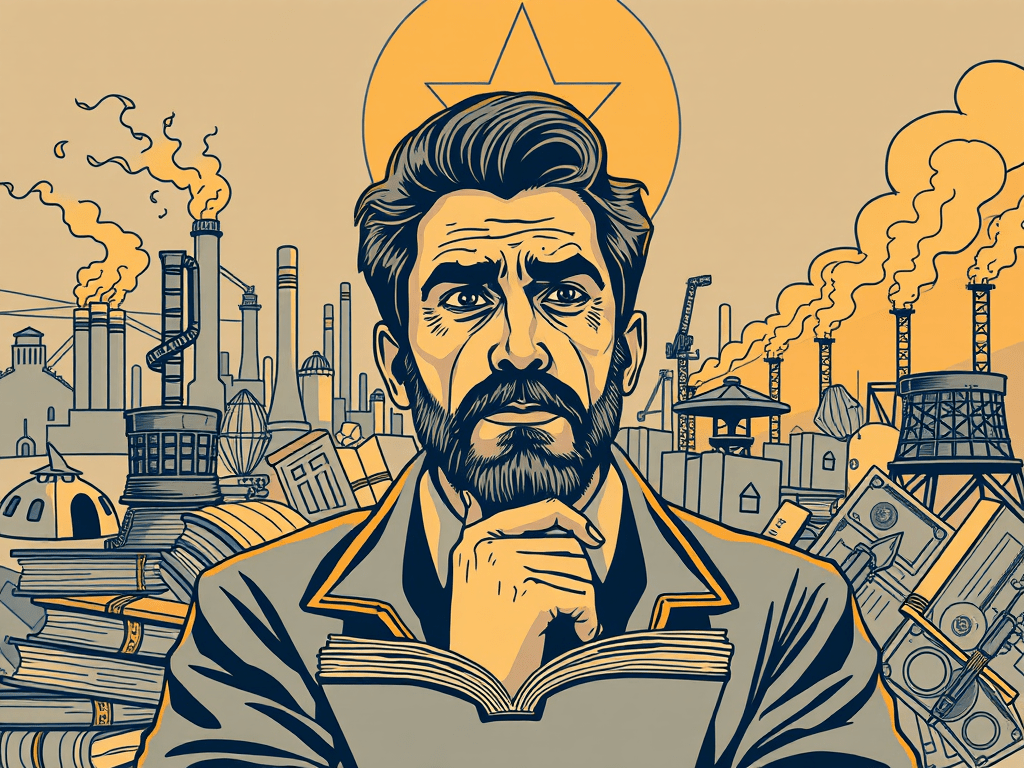
To declare oneself a Marxist in this day and age is to invite a hailstorm of suspicion and ridicule. The term itself has been battered and bruised by history, twisted into a caricature by its detractors and betrayed by its supposed adherents. Stalinist gulags, Maoist purges, and the gray bureaucracies of the Eastern Bloc are waved about as irrefutable evidence of Marxism’s inherent flaws, as though Karl Marx himself were personally complicit in their crimes. To the guardians of liberal orthodoxy, to declare oneself a Marxist is to confess to an intellectual heresy—one step away from donning a beret and plotting the collectivization of suburban lawns.
Yet here I am, unapologetically, a Marxist. Not a dogmatist, mind you—not one of those dreary types who turns every political conversation into a recital of Marxist scripture, or who sees the world as nothing more than a chessboard of oppressors and oppressed. At least, I hope I’m not! No, my Marxism is not the crude reductionism of the ideologue but the critical framework of the skeptic. It is an attitude, a lens, a method—a way of understanding the world as it is, rather than as we are told it should be.
What, then, does it mean to be a Marxist? At its core, Marxism is not an ideology but a critique—a ruthless, uncompromising critique of the structures of power and privilege that govern our lives. It begins with the simple observation that human society is not some harmonious Eden of free and equal individuals but a battlefield of conflicting interests, shaped above all by material conditions. Capitalism, for all its talk of liberty and opportunity, is revealed as a system riddled with contradictions: a machine that produces untold wealth while immiserating millions, that promises freedom while chaining us to the tyranny of markets, that generates innovation while devouring the planet in the name of profit.
To be a Marxist is to see these contradictions not as anomalies but as inherent features of the system. It is to understand that the pursuit of profit is not merely a harmless economic principle but a force that shapes every aspect of our lives, from the conditions of our labor to the choices we make at the ballot box, from the wars we fight abroad to the inequalities we tolerate at home. It is to see, in short, that the personal is political, that the economic is ideological, and that the seemingly neutral mechanisms of the market are, in fact, the instruments of domination.
Of course, Marxism is often caricatured as the philosophy of resentment, the bitter grumbling of those who envy the successful. Nothing could be further from the truth. Marxism is not a rejection of progress but a demand for it—a demand that the immense productive capacities of modern society be directed not toward the enrichment of a tiny elite but toward the fulfillment of human potential. It is, at its heart, an ethical critique, a vision of a world in which the fruits of labor are shared, in which freedom is more than the freedom to sell oneself to the highest bidder, in which the pursuit of happiness is not stunted by the demands of capital.
But let us not romanticize Marxism. It is not a blueprint for utopia or a magic formula for justice. It is, above all, a method—a way of thinking that refuses to take the status quo for granted, that insists on asking the uncomfortable questions, that demands we confront the realities of exploitation, alienation, and inequality. It is not a gospel but a guide, a framework for understanding the forces that shape our world and for imagining alternatives.
And yes, Marxism has been betrayed—betrayed by those who turned its vision of liberation into a pretext for tyranny, who mistook the state for the people and ideology for truth. But these betrayals are not the fault of Marxism any more than the abuses of organized religion are the fault of Christ or Muhammad. They are the result of human frailty, of the perennial temptation to use power not for justice but for domination. To reject Marxism because of its misuses is to reject medicine because of quackery.
To be a Marxist today is to swim against the tide, to challenge the triumphant narrative of neoliberal capitalism, which assures us that this is the best of all possible worlds and that no alternative is possible. It is to insist that another world is not only possible but necessary—a world in which human dignity is not a commodity, in which the fruits of progress are not hoarded by the few, in which the promise of democracy is not hollowed out by the realities of economic power.
I am a Marxist not because I believe in some utopian vision of a perfect society but because I refuse to accept the injustices of the present as inevitable. I am a Marxist because I believe in the power of critique, in the necessity of resistance, in the possibility of change. I am a Marxist because I am, above all, a humanist, and I cannot reconcile my commitment to human dignity with a system that treats human beings as mere instruments of profit.
To be a Marxist is not to have all the answers but to ask the right questions. And in a world as riddled with contradictions as ours, that is no small thing.
 Letters from Tomis
Leave a comment