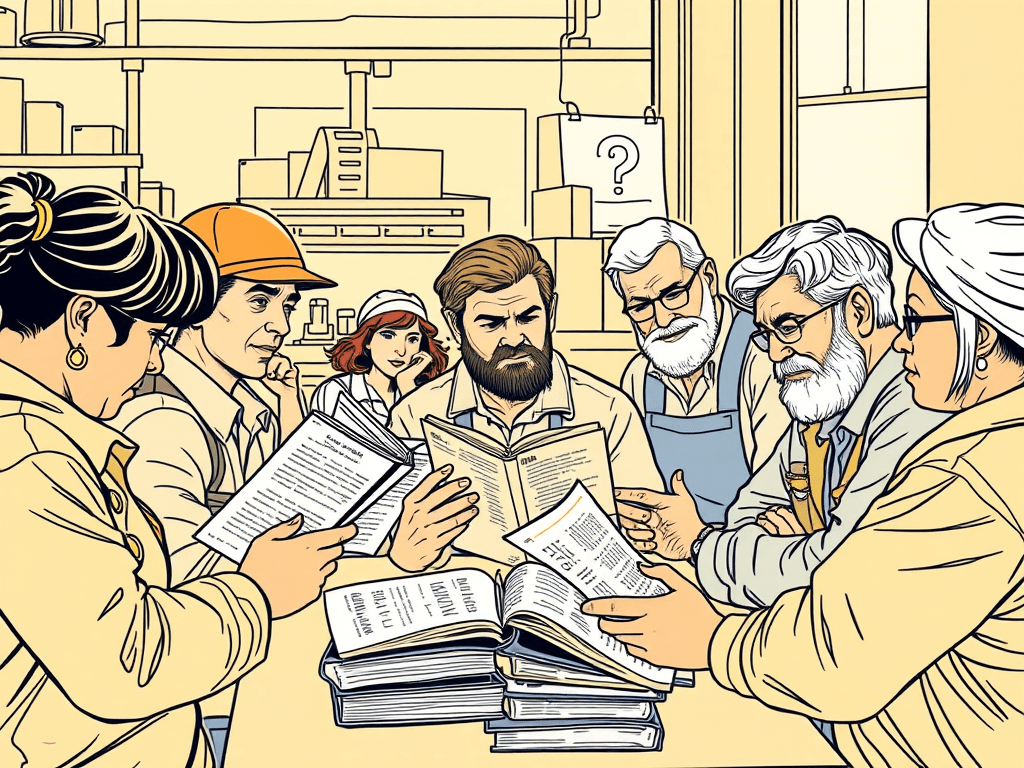
First in a series of reflections on my thoughts after reading What is Marxism: An Introduction into Marxist Theory by Rob Sewell and Alan Woods. The thoughts, opinions, and any errors are mine alone.
One of the most scandalous misconceptions in the tapestry of modern discourse is the belief that philosophy—the pursuit of wisdom and understanding—is the exclusive domain of the leisure class. The working class, we are told, has no need for such lofty abstractions. After all, what place do Aristotle, Spinoza, or Marx have on the factory floor or in the breakroom of a fast-food chain? This notion is not only false but insidious. It assumes, first, that philosophy is mere ornamentation rather than the critical apparatus by which human beings make sense of their world. Second, it perpetuates a debilitating intellectual disenfranchisement that keeps the working class both politically docile and culturally invisible.
Let us begin with the obvious: no one exists outside of philosophy. To live is to have a worldview, a framework through which we interpret reality, whether we articulate it or not. The working class is no exception; its members are bombarded daily by questions of justice, ethics, freedom, and identity—questions that are fundamentally philosophical. Yet, in the absence of formal philosophical tools, the answers to these questions are often imposed from above, by politicians, employers, and the vulgar machinery of mass culture. The result is a population that too often internalizes its own subjugation, mistaking the conditions of its oppression for the natural order of things.
This is not a new phenomenon. The ancient Athenians—those paragons of philosophical inquiry—understood that a populace deprived of intellectual empowerment is easily manipulated. Socrates, the gadfly of Athens, was executed not because he was irrelevant but because he was dangerous. His insistence on questioning authority threatened the stability of a society built on the unexamined acceptance of hierarchy. Likewise, any working-class movement that arms itself with philosophy poses a direct challenge to the structures that exploit it.
The working class needs a philosophy because it needs a voice. A well-articulated philosophy transforms grievances into demands, frustrations into movements, and alienation into solidarity. The labor strikes of the 19th and 20th centuries were not merely acts of desperation but philosophical assertions of human dignity. When workers banded together to demand an eight-hour workday, they were invoking a principle as old as Aristotle: that the good life requires time for leisure, contemplation, and self-realization.
But philosophy is not merely instrumental; it is also emancipatory. In his Theses on Feuerbach, Karl Marx famously declared, “The philosophers have only interpreted the world, in various ways; the point is to change it.” Yet Marx himself knew that interpretation and change are not mutually exclusive. A world misunderstood is a world unchanged. The working class must interpret its own reality, must see through the illusions spun by the ideologues of capital, who insist that wealth trickles down, that poverty is a personal failing, and that the only alternative to the current system is chaos.
Moreover, philosophy offers the working class a weapon against the cheap consolations of religion and nationalism—two opiates that have historically been used to dull its revolutionary potential. The factory worker, the teacher, the fast-food cook, the nurse—each deserves more than the hollow promise of paradise in the afterlife or the cynical exploitation of patriotic sentiment. They deserve, instead, the tools to construct a paradise on Earth.
And here lies the final point: philosophy is not a luxury but a necessity. It is not the preserve of tweed-clad academics or ivory-tower intellectuals but a birthright of every human being who has ever asked, “Why?” To deny the working class access to philosophy is to deny it the means to fully realize its humanity. It is to relegate millions to a life of intellectual starvation, where the richest questions are replaced with the thinnest answers.
Let us then reject this scandalous misconception. Let us argue, as Socrates argued, that the unexamined life is not worth living—and that this maxim applies no less to the janitor than to the philosopher-king. If the working class takes up the mantle of philosophy, it will not merely understand the world; it will remake it. And that, my friends, is a prospect worth toasting with the finest drink ever raised.
 Letters from Tomis
Leave a comment