Lecture
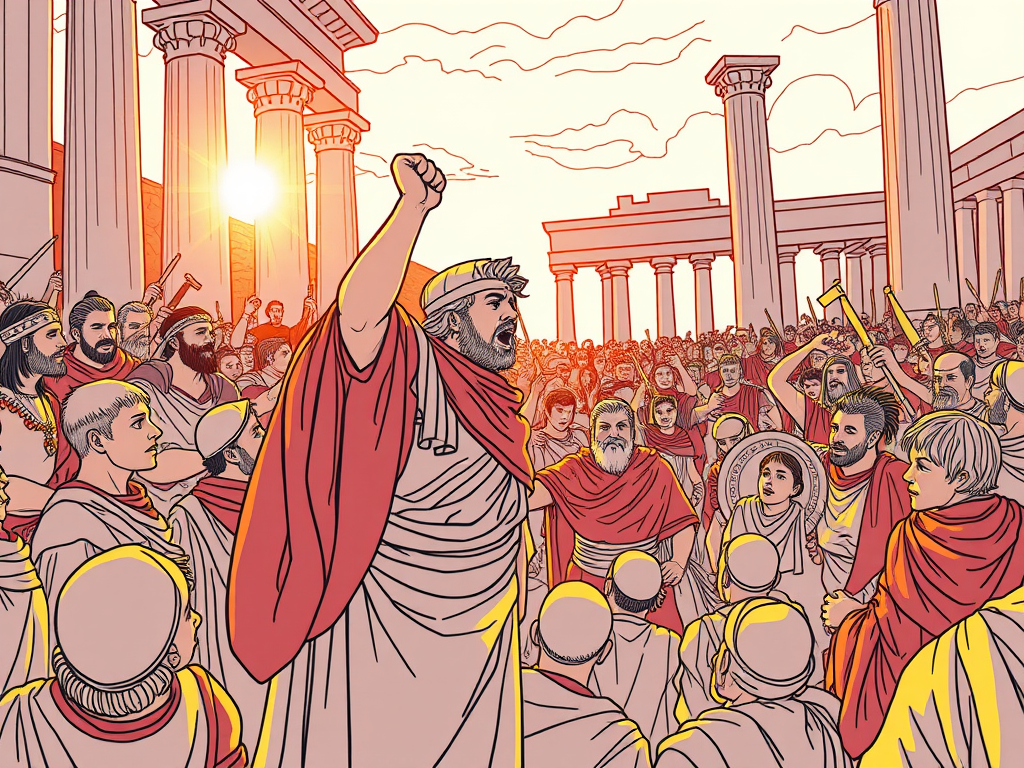
This is part 2 on a lecture on social revolutions. In this section, I delve deeper into the various causes and effects of these transformative events, exploring historical examples that illustrate the complexity and interconnectedness of social movements.
Key Points
– Research suggests the Roman Republic (509–27 BC) saw several social revolutions, including struggles for political equality and rights.
– The struggle of the orders (500–287 BC) likely saw plebeians gain political power, transforming Roman society.
– It seems likely that expansion led to increased inequality, with land reforms like the Gracchan efforts (133–121 BC) attempting to address this.
– The evidence leans toward the Social War (91–87 BC) and slave revolts, like Spartacus’s (73–71 BC), as significant challenges to the social order.
– The transition to the Empire under Augustus (27 BC) marked a major social shift, centralizing power and ending republican institutions.
Introduction
The Roman Republic, lasting from 509 BC to 27 BC, was a period of dynamic change, marked by social revolutions that reshaped its society. These revolutions involved struggles for political equality, rights, and challenges to the existing social order, driven by internal tensions and external expansion. This lecture will explore key events, providing a clear narrative for understanding these transformations.
The Struggle of the Orders
Early in the Republic, a significant social revolution was the struggle of the orders, a conflict between patricians (aristocrats) and plebeians (commoners) from 500 BC to 287 BC. Plebeians, initially excluded from political power, fought for and gradually gained rights. Key milestones included the creation of the tribune office in 494 BC to protect plebeian interests and the Law of the Twelve Tables in 449 BC, codifying laws for all citizens. By 367 BC, the Licinian-Sextian laws allowed plebeians to hold high offices like consul, marking a shift toward a more inclusive society.
Expansion and Social Impacts
As Rome expanded, conquering territories brought wealth and slaves, leading to social changes. The rise of large estates (latifundia) displaced small farmers, increasing urbanization and the urban poor. This widened the gap between rich and poor, weakening traditional patron-client relationships and fueling social unrest, setting the stage for further revolutionary movements.
The Gracchan Reforms
In response to growing inequality, the Gracchi brothers, Tiberius and Gaius, initiated reforms from 133 BC to 121 BC. Tiberius proposed land redistribution to limit elite land holdings, while Gaius expanded this with grain price controls and colonial settlements for the poor. These efforts faced fierce Senate opposition, leading to their violent deaths, highlighting the resistance to social revolution from above.
The Social War
The Social War (91–87 BC) saw Italian allies rebel against Rome, demanding citizenship denied to them despite their military contributions. Triggered by the assassination of Marcus Livius Drusus, the war ended with Rome granting citizenship, integrating allies into Roman society and marking a significant social and political shift.
Slave Revolts
Slave revolts, particularly the Third Servile War (73–71 BC) led by Spartacus, challenged the slavery-based social order. Starting with escaped gladiators, the revolt grew to 120,000, defeating Roman forces before being crushed by Crassus. This was a social revolution from below, threatening Rome’s economic foundation.
The End of the Republic
The late Republic saw civil wars, with the Catiline conspiracy (63 BC) revealing social discontent. Figures like Pompey and Julius Caesar’s rise led to further conflicts, culminating in Caesar’s dictatorship and assassination. Augustus’s rise in 27 BC transformed the Republic into an Empire, centralizing power and ending republican institutions, with profound social implications.
—
Survey Note: Social Revolutions During the Roman Republic
The Roman Republic, spanning from 509 BC to 27 BC, was a period of significant social transformations, often characterized as social revolutions due to their profound impact on class relations, political structures, and societal norms. This survey note provides a detailed examination of these events, drawing on historical sources and scholarly interpretations to offer a comprehensive overview for academic and lay audiences alike.
Historical Context and Definition
The Roman Republic emerged after the overthrow of the monarchy in 509 BC, establishing a system of elected magistrates and a Senate, initially dominated by patricians. Social revolutions, in this context, refer to significant shifts in social structure, such as changes in class dynamics, economic systems, and cultural norms, often driven by conflict or reform efforts. These revolutions were not always sudden but could unfold over decades, reflecting the complex interplay of internal and external factors.
The Struggle of the Orders (500–287 BC)
One of the earliest and most enduring social revolutions was the struggle of the orders, a conflict between patricians and plebeians. Patricians, the aristocratic elite, initially held all political and religious offices, while plebeians, the common citizens, were excluded. This struggle, lasting from 500 BC to 287 BC, saw plebeians organize and demand political equality. Key events included:
– First Secession (494 BC):** Plebeians withdrew from Rome to the Sacred Mount, forcing the creation of the tribune office to protect their interests, marking their first acquisition of real power.
– Law of the Twelve Tables (449 BC):** Codified Roman law, providing a written basis for legal rights, accessible to all, reducing patrician control over legal interpretation.
– Licinian-Sextian Laws (367 BC):** Allowed plebeians to hold the consulship, the highest magistracy, integrating them into the political elite.
This gradual democratization transformed Roman society, with plebeians achieving political equality by the 4th century BC, as noted in [Roman Republic](https://en.wikipedia.org/wiki/Roman_Republic). The process, while peaceful compared to later revolutions, was a fundamental shift, challenging the hereditary dominance of patricians.
Expansion and Social Impacts (3rd–2nd Century BC)
Rome’s expansion through conquests, particularly after the Punic Wars, brought significant social changes. The influx of wealth and slaves from conquered territories, such as Greece and North Africa, led to the rise of large estates (latifundia) worked by slaves, as detailed in [Ancient Rome – Social, Political, Economic | Britannica](https://www.britannica.com/place/ancient-Rome/Social-changes). This displaced small farmers, who migrated to urban centers like Rome, increasing the urban poor population. The growing disparity between rich and poor weakened traditional patron-client relationships, with the elite consolidating power, as seen in the 2nd century BC social dislocations. This shift from an agricultural to an urban, slave-based economy was a structural social revolution, contributing to later unrest.
The Gracchan Reforms (133–121 BC)
The Gracchan reforms, led by Tiberius and Gaius Gracchus, were a direct response to these inequalities. Tiberius, as tribune in 133 BC, proposed the Lex Sempronia Agraria, limiting public land holdings and redistributing excess to landless citizens, aiming to restore the smallholder class, as described in [Gracchi brothers](https://en.wikipedia.org/wiki/Gracchi_brothers). Gaius, in 123–122 BC, expanded this with grain price controls, colonial settlements, and citizenship proposals for allies, reflecting Greek theoretical influences. However, Senate opposition, fearing loss of power, led to their violent deaths, with Tiberius killed in 133 BC and Gaius in 121 BC. These reforms, while unsuccessful, were a revolutionary attempt to address social and economic disparities, setting a precedent for future conflicts, as noted in [Ancient Rome – Gracchi Reforms, 133-121 BC | Britannica](https://www.britannica.com/place/ancient-Rome/The-reform-movement-of-the-Gracchi-133-121-bc).
The Social War (91–87 BC)
The Social War, also known as the Italian War, was a rebellion by Rome’s Italian allies (socii) demanding citizenship, as detailed in [Social War | Roman Republic, Conflict & Causes | Britannica](https://www.britannica.com/event/Social-War-Roman-history). Triggered by the assassination of Marcus Livius Drusus in 91 BC, who proposed citizenship expansion, the allies formed a confederation, renaming Corfinium as Italia. The war, lasting from 91 to 87 BC, ended with Rome granting citizenship, integrating Italians into the Roman citizen body. This was a social revolution, expanding political rights and altering the social fabric, with lasting impacts on Roman hegemony, as seen in [Social War (91–87 BC)](https://en.wikipedia.org/wiki/Social_War_%2891%E2%80%9387_BC%29).
Slave Revolts, Including the Third Servile War (73–71 BC)
Slave revolts, particularly the Third Servile War led by Spartacus, challenged the slavery-based social order. Starting in 73 BC with 70 escaped gladiators from Capua, the revolt grew to 120,000, defeating Roman forces, as described in [Third Servile War](https://en.wikipedia.org/wiki/Third_Servile_War). Spartacus, a Thracian gladiator, led a surprisingly effective army, threatening Rome’s heartland. Crassus eventually crushed the revolt in 71 BC, crucifying 6,000 rebels along the Appian Way. This was a social revolution from below, highlighting the fragility of Rome’s slave economy, with implications for later political instability, as noted in [The Servile Wars & Spartacus: Slave Rebellions In The Roman Republic | HistoryExtra](https://www.historyextra.com/period/roman/servile-wars-what-when-spartacus/).
The End of the Republic and Transition to Empire (Late 1st Century BC)
The late Republic saw escalating social and political tensions, culminating in civil wars. The Catiline conspiracy in 63 BC, led by Lucius Sergius Catiline, aimed to overthrow the government, driven by economic discontent, as mentioned in [Rome’s Transition from Republic to Empire](https://education.nationalgeographic.org/resource/romes-transition-republic-empire/). Cicero’s suppression highlighted growing instability. Figures like Pompey, Caesar, and the First Triumvirate led to further conflicts, with Caesar’s dictatorship (49–44 BC) and assassination marking a turning point. Augustus, as Octavian, established the Empire in 27 BC, centralizing power and ending republican institutions, as detailed in [Roman Republic](https://en.wikipedia.org/wiki/Roman_Republic). This transformation had profound social implications, shifting from a republican to an imperial order, with the Senate’s role diminished, as seen in [How the Roman Republic became the Roman Empire](https://alexandermeddings.com/history/ancient-history/how-roman-republic-became-roman-empire/).
Comparative Analysis and Scholarly Perspectives
Modern scholarship, such as [Crisis of the Roman Republic](https://en.wikipedia.org/wiki/Crisis_of_the_Roman_Republic), debates the causes and nature of these revolutions, with some viewing them as responses to economic inequality and others as political power struggles. The struggle of the orders is seen as a gradual democratization, while the Gracchan reforms and Social War are often interpreted as revolutionary attempts to address systemic issues, with varying success. Slave revolts, particularly Spartacus’s, are noted for their direct challenge to the social order, with long-term impacts on Roman politics.
Table: Key Social Revolutions in the Roman Republic
| Event | Period | Key Actors | Main Impact |
|---|---|---|---|
| Struggle of the Orders | 500–287 BC | Patricians, Plebeians | Plebeians gained political equality |
| Expansion and Inequality | 3rd–2nd Century BC | Elite, Small Farmers | Rise of latifundia, urban poor growth |
| Gracchan Reforms | 133–121 BC | Tiberius, Gaius Gracchus | Attempted land redistribution, met resistance |
| Social War | 91–87 BC | Italian Allies, Roman Senate | Citizenship granted, integration of Italians |
| Third Servile War | 73–71 BC | Spartacus, Roman Forces | Challenged slavery, suppressed by Crassus |
| Transition to Empire | Late 1st Century BC | Caesar, Augustus, Senate | Centralized power, ended republican institutions |
This table summarizes the timeline, actors, and impacts, providing a structured overview for further analysis.
Conclusion
The Roman Republic’s social revolutions, from the struggle of the orders to the transition to Empire, reflect a society in constant flux, driven by class conflicts, economic changes, and political reforms. These events not only shaped Roman history but also left a legacy for understanding social dynamics in ancient and modern contexts.
Key Citations
– [Ancient Rome – Social, Political, Economic | Britannica](https://www.britannica.com/place/ancient-Rome/Social-changes)
– [Conflict of the Orders](https://en.wikipedia.org/wiki/Conflict_of_the_Orders)
– [The Roman Republic: Rise and Expansion | Medium](https://scanderbegal.medium.com/the-roman-republic-rise-and-expansion-171eb477a8c7)
– [Gracchi brothers](https://en.wikipedia.org/wiki/Gracchi_brothers)
– [Social War | Roman Republic, Conflict & Causes | Britannica](https://www.britannica.com/event/Social-War-Roman-history)
– [Third Servile War](https://en.wikipedia.org/wiki/Third_Servile_War)
– [Roman Republic](https://en.wikipedia.org/wiki/Roman_Republic)
– [Ancient Rome – Gracchi Reforms, 133-121 BC | Britannica](https://www.britannica.com/place/ancient-Rome/The-reform-movement-of-the-Gracchi-133-121-bc)
– [Social War (91–87 BC)](https://en.wikipedia.org/wiki/Social_War_%2891%E2%80%9387_BC%29)
– [The Servile Wars & Spartacus: Slave Rebellions In The Roman Republic | HistoryExtra](https://www.historyextra.com/period/roman/servile-wars-what-when-spartacus/)
– [Rome’s Transition from Republic to Empire](https://education.nationalgeographic.org/resource/romes-transition-republic-empire/)
– [How the Roman Republic became the Roman Empire](https://alexandermeddings.com/history/ancient-history/how-roman-republic-became-roman-empire/)
– [Crisis of the Roman Republic](https://en.wikipedia.org/wiki/Crisis_of_the_Roman_Republic)
 Letters from Tomis
Leave a comment