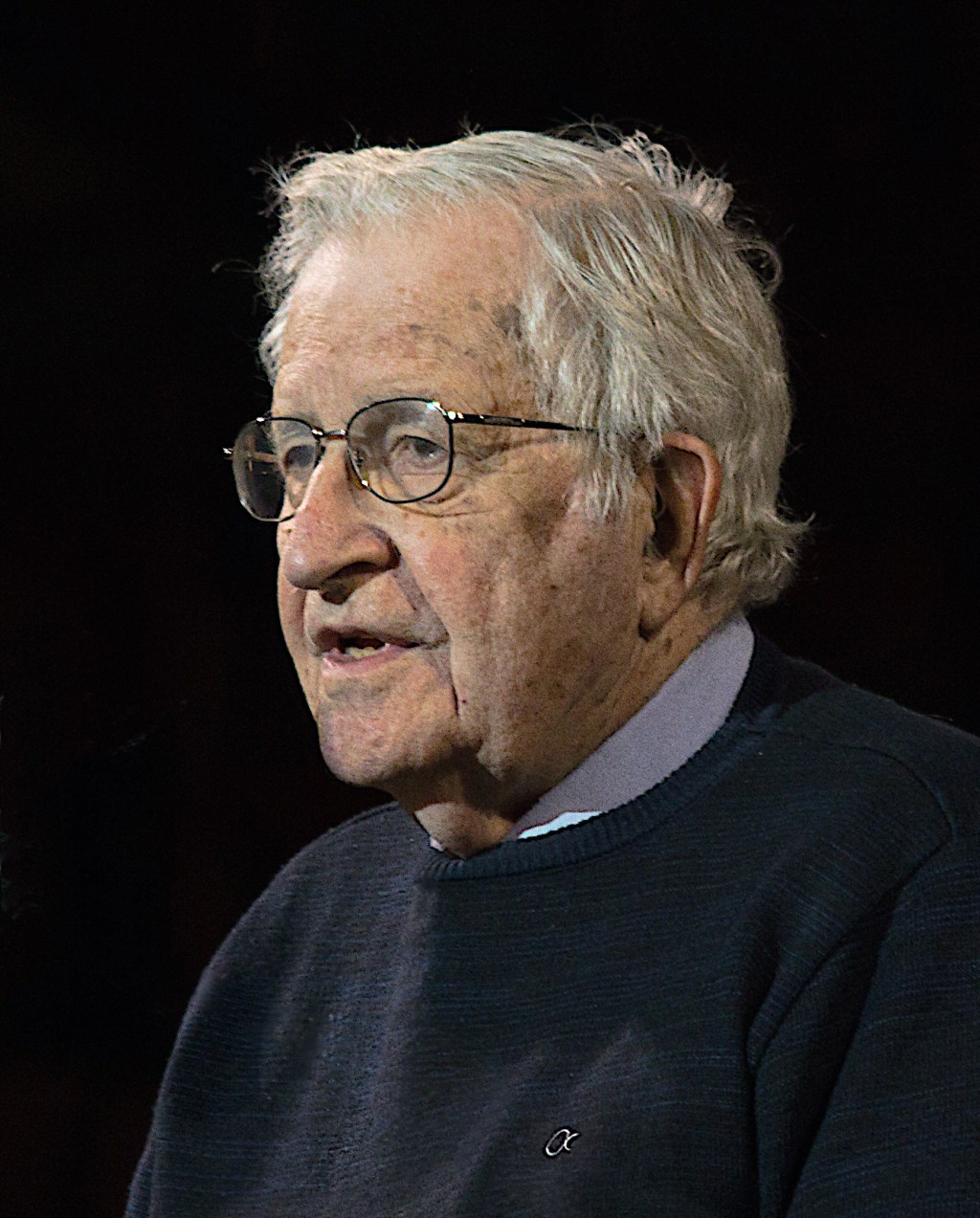
My Socialist Hall of Fame
During this chaotic era of vile rhetoric and manipulative tactics from our so-called bourgeois leaders, I am invigorated by the opportunity to reflect on Socialists, Revolutionaries, Philosophers, Guerrilla Leaders, Partisans, and Critical Theory titans, champions, and martyrs who paved the way for us—my own audacious “Socialism’s Hall of Fame.” These are my heroes and fore-bearers. Not all are perfect, or even fully admirable, but all contributed in some way to our future–either as icons to emulate, or as warnings to avoid in the future.
Early Life and Education
Avram Noam Chomsky was born on December 7, 1928, in Philadelphia, Pennsylvania, USA. He was raised in an intellectually stimulating environment, as his father, William Chomsky, was a noted Hebrew scholar, and his mother, Elsie Simonofsky Chomsky, was an educator. From an early age, Chomsky showed an interest in language, politics, and philosophy.
Chomsky attended the University of Pennsylvania, where he earned his B.A. (1949), M.A. (1951), and Ph.D. (1955) in linguistics. Under the mentorship of Zellig Harris, he developed an early interest in structural linguistics but soon broke away from the dominant behaviorist model, formulating his own revolutionary theories.
Linguistic Contributions and “Chomskyan Revolution”
Chomsky is best known for his work in theoretical linguistics, particularly his development of generative grammar, a theory that posits that the ability to produce and understand language is innate to the human mind. His 1957 book, Syntactic Structures, introduced transformational-generative grammar, challenging prevailing behaviorist views of language acquisition, such as those proposed by B.F. Skinner.
His concept of the universal grammar (UG)—the idea that all human languages share a deep structural framework—had a profound impact on the fields of linguistics, cognitive science, and psychology. His theories laid the groundwork for modern computational linguistics and artificial intelligence.
Political Activism and Critique of Power
Beyond linguistics, Chomsky is widely known for his radical political views and critique of U.S. foreign policy, capitalism, and mainstream media. Influenced by anarchist and libertarian socialist thought, he has been a fierce critic of corporate power, imperialism, and state propaganda. His book Manufacturing Consent: The Political Economy of the Mass Media (1988), co-authored with Edward S. Herman, introduced the propaganda model, which argues that mass media serves elite interests by shaping public perception.
During the Vietnam War, Chomsky became an outspoken critic of U.S. intervention and was arrested for his activism. Over the decades, he has remained an influential voice in global political discourse, commenting on issues such as neoliberalism, climate change, and human rights.
Later Years and Legacy
Chomsky spent most of his academic career at the Massachusetts Institute of Technology (MIT), where he worked from 1955 to 2017. In 2017, he joined the University of Arizona as a laureate professor. Even in his 90s, he continues to lecture and write prolifically on linguistic theory and political affairs.
His impact on multiple disciplines—from linguistics and philosophy to political science and media studies—remains unparalleled. He is regarded as one of the most cited scholars of all time.
Selected Bibliography
Linguistics
1. Syntactic Structures (1957)
2. Aspects of the Theory of Syntax (1965)
3. The Sound Pattern of English (with Morris Halle, 1968)
4. Language and Mind (1972)
5. The Minimalist Program (1995)
6. What Kind of Creatures Are We? (2015)
Politics and Media Critique
1. American Power and the New Mandarins (1969)
2. Manufacturing Consent: The Political Economy of the Mass Media (with Edward S. Herman, 1988)
3. Profit Over People: Neoliberalism and Global Order (1999)
4. Hegemony or Survival: America’s Quest for Global Dominance (2003)
5. Requiem for the American Dream (2017)
Chomsky’s work continues to inspire and challenge scholars, activists, and thinkers worldwide, ensuring his place as one of the most influential intellectuals of the modern era.
 Letters from Tomis
Leave a comment