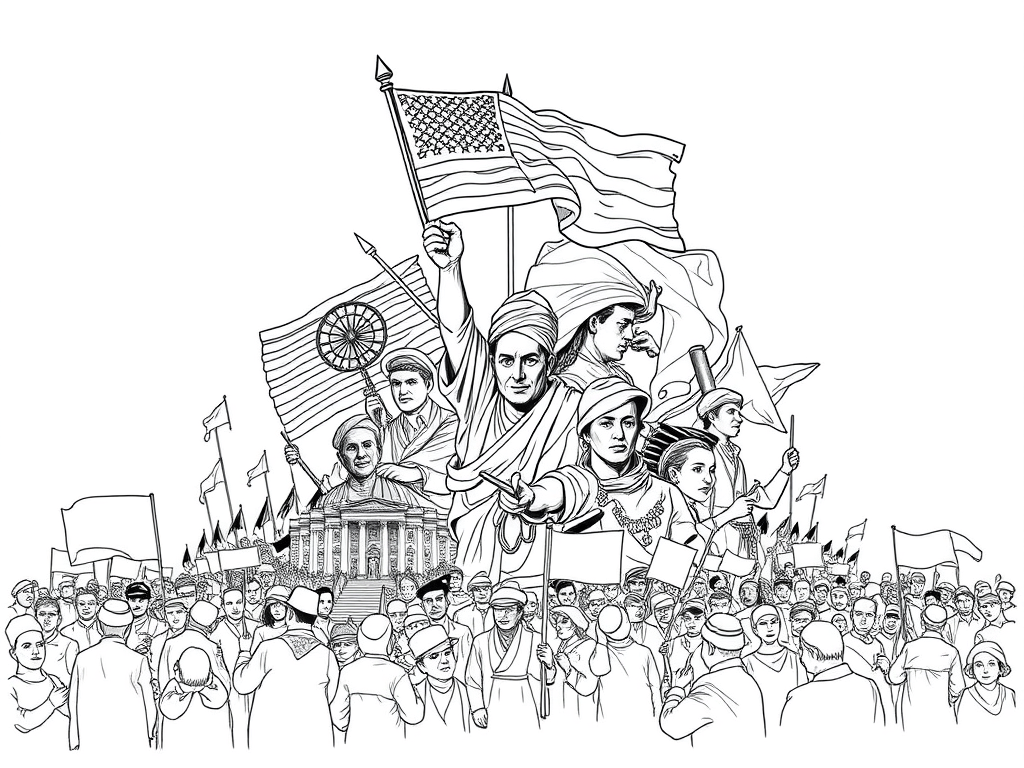
Lecture
Here are notes for lecture on social revolutions.
Introduction
Social revolutions have shaped the course of human history, overthrowing established systems and introducing radical political, economic, and cultural changes. These revolutions often arise from deep societal grievances, economic hardship, and political oppression, culminating in mass movements that challenge the status quo. In this lecture, we will explore the history of social revolutions, their causes, major examples, and their lasting impacts.
I. Defining Social Revolution
A social revolution is a fundamental and rapid transformation of a society’s structures, often involving mass participation and the overthrow of existing political or economic systems. Unlike mere political coups or reforms, social revolutions aim to change the underlying social fabric, often through widespread upheaval.
Key Characteristics of Social Revolutions
• Driven by widespread dissatisfaction with the status quo.
• Involve mass mobilization and popular support.
• Lead to deep structural changes in society.
• Often accompanied by violence, though some are peaceful.
II. Early Social Revolutions
While revolutions have occurred throughout history, some early examples set the stage for modern movements.
1. The English Revolution (1642–1660)
• The English Civil War saw conflict between King Charles I and Parliament.
• It resulted in the temporary establishment of the Commonwealth under Oliver Cromwell.
• Introduced ideas of constitutional government and the limitation of monarchical power.
2. The American Revolution (1775–1783)
• A struggle against British colonial rule, led by the 13 American colonies.
• Resulted in the creation of the United States and the first modern democratic republic.
• Introduced Enlightenment principles of liberty, equality, and representative government.
III. The Age of Revolutions (18th–19th Century)
The late 18th and 19th centuries were marked by a series of major revolutions that reshaped global politics.
1. The French Revolution (1789–1799)
• One of the most radical revolutions in history, overthrowing the monarchy and establishing a republic.
• Led to the Reign of Terror and significant social and legal reforms.
• Introduced the ideals of “Liberty, Equality, Fraternity,” inspiring future revolutionary movements.
2. The Haitian Revolution (1791–1804)
• The first successful slave-led revolution in history.
• Led by Toussaint Louverture, enslaved people in Haiti overthrew French colonial rule.
• Established the first independent Black republic, challenging European imperialism.
3. The Revolutions of 1848
• A series of uprisings across Europe, demanding democracy, labor rights, and national unification.
• Though most were suppressed, they laid the groundwork for future social and political reforms.
IV. 20th Century Social Revolutions
The 20th century saw some of the most significant revolutions that shaped modern political ideologies.
1. The Russian Revolution (1917)
• Led by the Bolsheviks under Vladimir Lenin, it overthrew the Russian monarchy and established the Soviet Union.
• Introduced Marxist-Leninist socialism and became a model for communist revolutions worldwide.
• Triggered global ideological conflicts, including the Cold War.
2. The Chinese Communist Revolution (1949)
• Led by Mao Zedong and the Communist Party, it overthrew the Nationalist government.
• Transformed China into a socialist state, with widespread land reforms and industrialization.
• Laid the foundation for modern China’s economic and political structure.
3. The Cuban Revolution (1959)
• Led by Fidel Castro and Che Guevara, it overthrew the U.S.-backed Batista regime.
• Established a socialist state in the Western Hemisphere, influencing Latin American revolutionary movements.
4. The Iranian Revolution (1979)
• A unique revolution that combined religious fundamentalism with mass social movements.
• Overthrew the Western-backed Shah and established an Islamic Republic under Ayatollah Khomeini.
• Marked a shift toward religious-based governance in modern revolutions.
V. Contemporary Social Movements as Revolutions
While traditional revolutions often involved violent uprisings, modern social revolutions take different forms.
1. Civil Rights Movements
• The U.S. Civil Rights Movement (1950s–1960s) fought against racial segregation and discrimination.
• Led by figures like Martin Luther King Jr. and Malcolm X, it resulted in landmark legislation.
2. The Arab Spring (2010–2012)
• A wave of uprisings across the Middle East and North Africa.
• Overthrew dictatorships in Tunisia, Egypt, and Libya, though with mixed long-term results.
3. Digital and Decentralized Movements
• The rise of social media has enabled movements like #MeToo, Black Lives Matter, and climate change activism.
• These movements challenge traditional power structures without centralized leadership.
VI. The Legacy and Impact of Social Revolutions
Social revolutions shape the world by transforming political systems, economies, and cultural norms.
1. Expansion of Rights
• Many revolutions led to the expansion of political and civil rights.
• Women’s suffrage, labor laws, and minority rights emerged from revolutionary struggles.
2. Challenges and Failures
• Some revolutions resulted in authoritarian regimes (e.g., the Soviet Union under Stalin).
• Others led to prolonged instability and conflict (e.g., Libya post-Arab Spring).
3. The Ongoing Nature of Revolution
• Social revolutions are continuous processes; movements for justice, democracy, and equality persist worldwide.
Conclusion
Social revolutions are a defining feature of human history, reshaping societies in profound ways. While each revolution is unique, they share common patterns of struggle, transformation, and legacy. As we continue to witness new forms of social activism and resistance, it is essential to understand the lessons of the past to shape a more just and equitable future.
Possible Discussion Questions:
1. How do modern social movements compare to historical revolutions?
2. Can a revolution be entirely peaceful and still be effective?
3. What role does technology play in today’s revolutionary movements?
4. Are revolutions necessary for meaningful social change, or can reforms achieve the same goals?
 Letters from Tomis
Leave a comment