An ongoing series of reflections of my thoughts on historical materialism after reading What is Marxism: An Introduction into Marxist Theory by Rob Sewell and Alan Woods. The thoughts, opinions, and any errors are mine alone.
It is an axiom of historical materialism, that in order to understand the trajectory of human societies, one must analyze not the motives or philosophies that adorned their walls but the material conditions and modes of production that built those walls in the first place. The Marxist understanding of the Neolithic Revolution—a seismic shift in human history from foraging to agriculture—offers a robust lens through which to see the underpinnings of civilization itself. By grounding itself in the realities of production and labor, historical materialism unveils the Neolithic Revolution as the first, profound moment in which humanity’s productive forces outpaced the modes of subsistence, creating not merely new means of survival but new relations of power, inequality, and exploitation.
The Historical Materialist Framework
Karl Marx and Friedrich Engels argued that the economic base—composed of the forces and relations of production—determines the superstructure of politics, culture, and ideology. In the Neolithic period (roughly 10,000 years ago), the development of agriculture marked a monumental transformation in the economic base. For thousands of years, humanity had eked out its existence as hunter-gatherers, a mode of production characterized by communal relations. The land was no one’s to own, for its bounty was fleeting, dispersed, and contingent on luck or skill. In such societies, material scarcity limited the potential for class antagonisms or concentrated power.
However, with the advent of agriculture, this precarious equilibrium was disrupted. The ability to cultivate land, domesticate animals, and store surplus food shifted the balance from communal survival to private accumulation. As Engels noted in The Origin of the Family, Private Property, and the State, the surplus created by agriculture laid the groundwork for inequality. Those who controlled the land and its yield could extract labor and wealth from those who worked it. The emergence of class divisions began not as a philosophical innovation but as a material necessity derived from surplus production.
From Scarcity to Surplus: The Dialectic of Progress and Exploitation
The transition to agriculture was not a simple tale of progress. It was, in fact, a dialectical process—simultaneously liberating and oppressing. On one hand, agriculture allowed humanity to transcend the immediate tyranny of nature, enabling larger populations and more complex societies. Yet on the other, it shackled the majority to the yoke of toil and introduced unprecedented forms of exploitation.
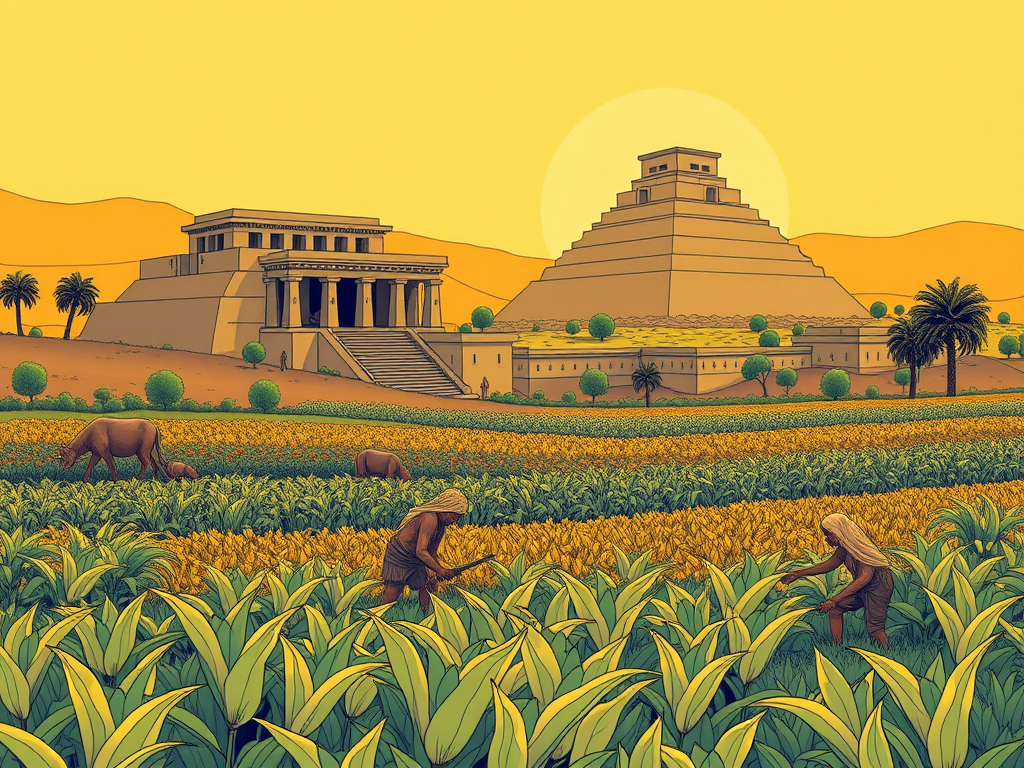
Take, for instance, the early city-states of Mesopotamia. Here, the agricultural surplus allowed the rise of a priestly class, whose control over both grain storage and spiritual ideology justified their dominance. The Ziggurats of Sumeria, those towering temples of baked clay, were monuments not just to religious devotion but to the labor extracted from the agrarian masses. Historical materialism reveals these temples as both ideological tools of the ruling class and symbols of the new economic base—a base that demanded surplus extraction and centralized control.
Similarly, in the Americas, the Mayans and Aztecs created sophisticated agricultural systems—terraces, irrigation, and chinampas—capable of sustaining vast populations. Yet these achievements came at the cost of a rigid hierarchy in which the priest-king presided over both the material and spiritual wealth of society. The same productive forces that allowed human flourishing also entrenched human suffering in ways previously unimaginable.
Gender and Division of Labor: The Other Half of the Story
One cannot consider the Marxist understanding of the Neolithic Revolution without addressing the gendered division of labor. In hunter-gatherer societies, evidence suggests that women’s roles as gatherers and preparers of food were as crucial as men’s roles in hunting. However, the rise of agriculture reconfigured gender relations. The privatization of land and the control of surplus placed men—those who typically wielded the plow—in positions of economic dominance. Women, in turn, became increasingly subordinated, their labor confined to the domestic sphere. Engels argued that this was the “world historical defeat of the female sex,” an outcome not of biological determinism but of material conditions.
Conclusion: The Eternal Return of the Material
To view the Neolithic Revolution through a Marxist lens is to understand it not as a moral or spiritual awakening but as a necessary development in humanity’s productive forces. Its legacy is a contradictory one: the foundation of civilization itself, yet also the origin of class struggle, oppression, and inequality. As Marx wrote in The German Ideology, “The ideas of the ruling class are in every epoch the ruling ideas.” But ideas, as historical materialism insists, are secondary to the material realities that give birth to them.
Even today, as we grapple with the inequalities spawned by capitalism, we are haunted by the contradictions of that long-ago revolution. The surplus that promised freedom has so often delivered tyranny, the progress that lifted us from nature’s grip has so often enslaved us anew. The lesson of the Neolithic Revolution is the lesson of Marxism itself: that history is not a march of moral improvement but a series of conflicts born from material necessity. To change history, we must first understand it—not in terms of ideals, but in terms of the labor, land, and resources that have shaped our every epoch.
 Letters from Tomis
Leave a comment