Fifth in a series of reflections on my thoughts after reading What is Marxism: An Introduction into Marxist Theory by Rob Sewell and Alan Woods. The thoughts, opinions, and any errors are mine alone.
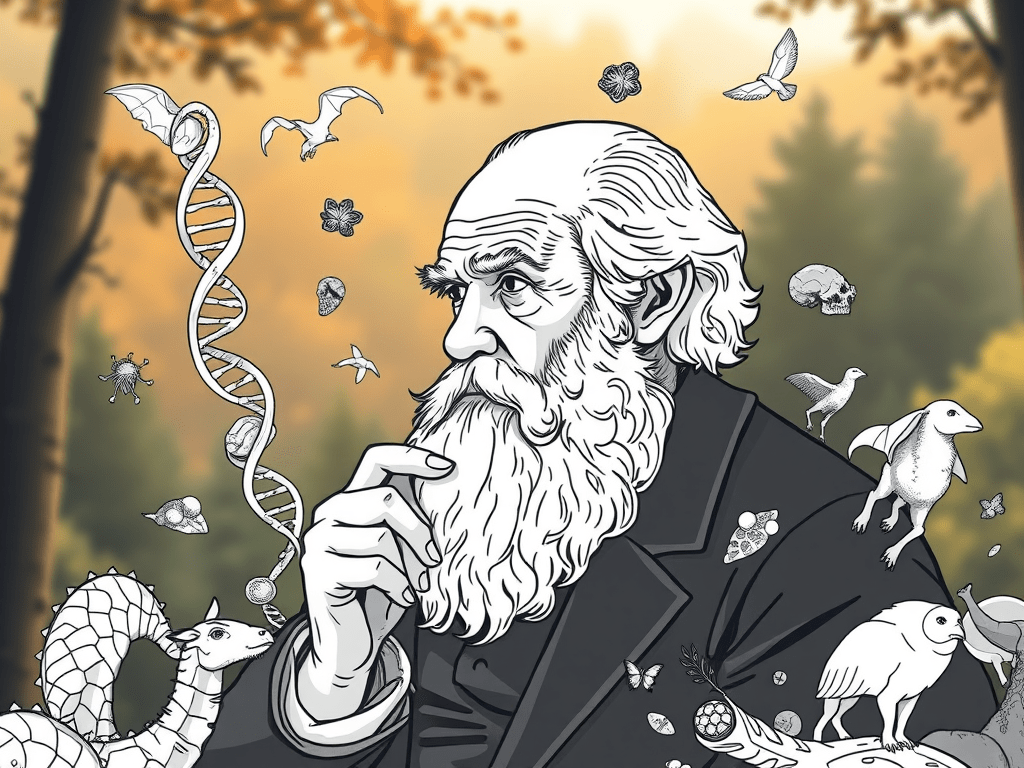
It is a strange but illuminating fact that the most important ideas in human history tend to inspire their greatest resistance not from obscurantists alone, but from those who might otherwise be considered their intellectual kin. Charles Darwin’s theory of evolution by natural selection is a prime example of this phenomenon. More than a scientific breakthrough, it is a profound and unsettling idea that has reshaped not only biology but the very way we understand our place in the cosmos. Its implications for philosophy, ethics, and theology are seismic—hence the relentless attempts to evade or neuter it.
Let us begin with the facts, as Darwin himself would have insisted. The theory of evolution, as presented in On the Origin of Species, is one of the most thoroughly substantiated ideas in the history of science. It is not a “theory” in the lay sense of the word—some idle speculation or hypothesis waiting for corroboration. It is, rather, an explanatory framework that unites countless observations from paleontology, genetics, embryology, and ecology. The fossil record, though incomplete, reveals a pattern of gradual transformation over vast stretches of time. DNA sequencing, a discovery that Darwin himself could not have anticipated, now provides an irrefutable map of common ancestry among all living organisms. To question the correctness of evolution in light of this overwhelming evidence is not an act of skepticism but of denial.
Yet the resistance to Darwinism persists, often clothed in the garb of philosophical or theological sophistication. Here, the issue becomes not one of scientific illiteracy but of metaphysical unease. Evolution tells us that life is contingent, that our species is the product of countless blind trials and errors rather than any overarching purpose or design. This is a deeply unflattering message for a creature as vain as Homo sapiens. We recoil at the idea that our exalted faculties—our reason, morality, and capacity for love—are not divine endowments but adaptations forged in the crucible of survival.
For philosophers, this revelation is both a challenge and an opportunity. The challenge lies in confronting the disquieting implications of Darwin’s insight without retreating into comforting myths. The opportunity lies in using evolution as a lens through which to reconsider some of the perennial questions of philosophy: What is the nature of human nature? Whence morality? What does it mean to live a meaningful life in a purposeless universe?
Darwin’s theory forces us to abandon the idea of humanity as separate from, or superior to, the rest of the natural world. This shift has profound ethical consequences. If we are not set apart by divine fiat, then our responsibilities toward other living beings become more urgent, not less. The suffering of an animal in a factory farm, the destruction of a rainforest, the extinction of a species—these are not just ecological crises but moral failures. Evolutionary biology does not prescribe an ethical system, but it undermines any worldview that denies our kinship with the rest of life on Earth.
Moreover, Darwinism compels us to rethink the origins of morality itself. Far from being the exclusive province of religion, morality arises from our evolutionary history as social animals. Altruism, empathy, and even a sense of justice have their roots in the survival strategies of our ancestors. This does not make them less real or less binding. On the contrary, understanding morality as a natural phenomenon enriches our appreciation of its complexity and adaptability.
Some critics have accused Darwin’s theory of fostering a nihilistic worldview, but this is a failure of imagination rather than an indictment of the theory itself. To see life as the result of billions of years of unthinking, impersonal processes is not to strip it of meaning but to imbue it with a new kind of wonder. The improbability of our existence, the fragile beauty of the ecosystems that sustain us, and the intricate tapestry of life on Earth—all these become more, not less, astonishing when viewed through the lens of evolution.
In the final analysis, Darwin’s theory of evolution is not just correct; it is indispensable. It is a foundational truth that must be reckoned with by anyone engaged in serious philosophical inquiry. To ignore it, or to misunderstand it, is to forfeit any claim to intellectual integrity. As Darwin himself might have said, the grandeur of this view of life lies not only in its scientific elegance but in its power to deepen our understanding of ourselves and our place in the universe. To paraphrase another great thinker, once we have seen this truth, we cannot unsee it—and nor should we wish to.
Thus, let us not fear Darwin’s theory but embrace it, with all its disquieting implications and exhilarating possibilities. For in doing so, we honor not only the man himself but the enduring, restless curiosity that defines the best of the human spirit.
 Letters from Tomis
Leave a comment