Greece
-
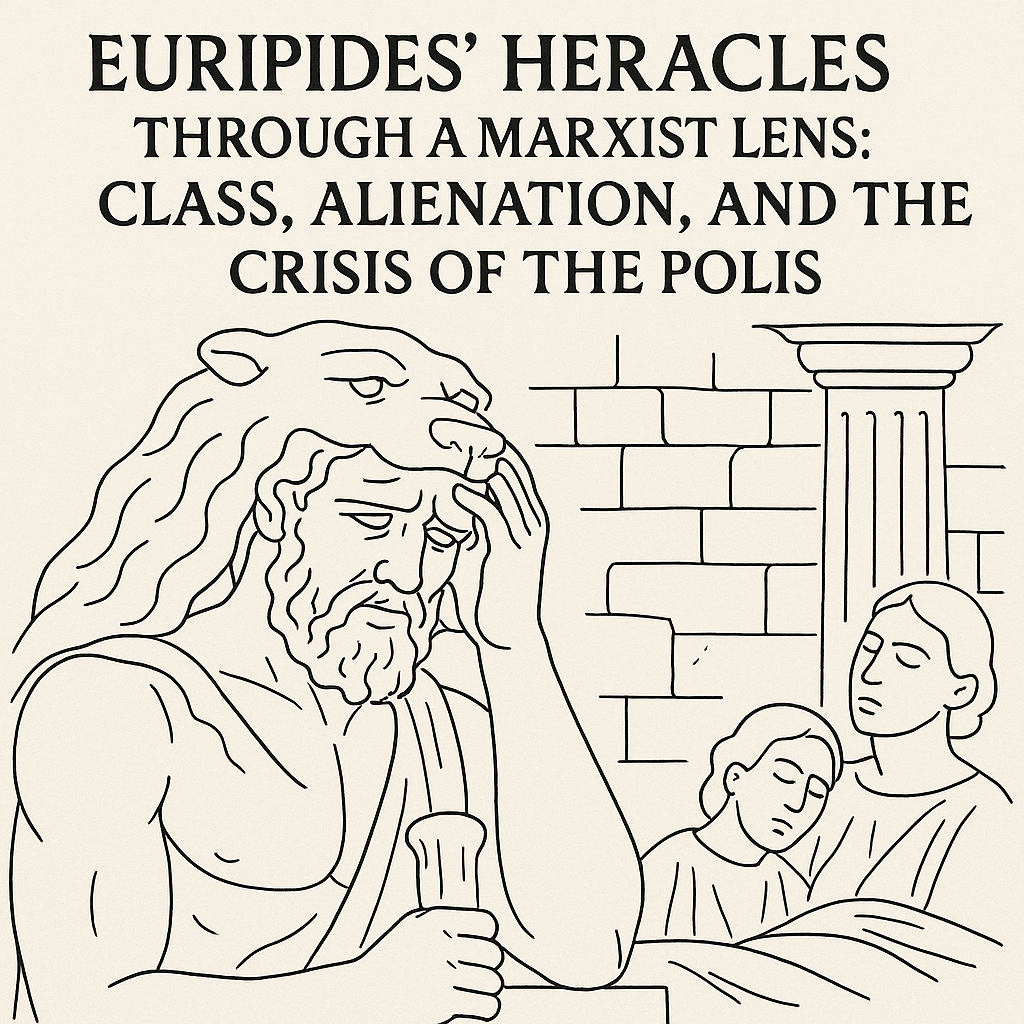
Euripides’ Heracles reveals the decay of a society sustained by conquest and patriarchy. Through a Marxist lens, the hero’s madness becomes the mirror of class alienation—his strength exploited, his humanity destroyed. The tragedy exposes not divine will, but the self-destruction of a world built upon labor, domination, and ideological illusion.
-
In Women of Trachis, Sophocles exposes the intertwined oppressions of patriarchy and class. Deianeira’s doomed devotion, Herakles’ violent labors, and Iole’s enforced silence reveal a society sustained by domination. Through a Marxist lens, the tragedy becomes a mirror of alienated labor, gendered suffering, and the contradictions of a slaveholding order.
-

James Davidson’s “Courtesans and Fishcakes” explores Athenian social life through a lens of consumption, emphasizing class relations and material production. By focusing on food, sex, and political discourse, Davidson reveals how pleasures are intertwined with labor exploitation in a slave-based economy, prompting a Marxist critique of cultural practices and underlying socio-economic frameworks.
-

Nicos Poulantzas was a Greek Marxist theorist whose work focused on the state, political power, and class structure. Influenced by various intellectual traditions, he developed a structuralist theory of the capitalist state, later evolving to a strategic-relational approach. Poulantzas engaged with politics through Eurocommunism, leaving a lasting impact on Marxist political theory before his untimely…
-

The Communist Party of Greece (KKE), founded in 1918, embodies a resilient history of Marxist-Leninist struggle against imperialism and bourgeois oppression. Active in various pivotal moments, such as WWII and the Greek Civil War, it remains a vital force in advocating for revolutionary socialism amidst contemporary neoliberal challenges, maintaining its ideological integrity.
 Letters from Tomis