Book Reviews
-

Sigmund Freud’s The Psychopathology of Everyday Life (1901) explores how everyday errors reflect repressed thoughts and unconscious desires. The text challenges traditional views of consciousness, emphasizing the unconscious’s influence on behavior. Freud’s analysis remains relevant and accessible, inviting interdisciplinary engagement and providing a foundational framework for understanding human cognition and behavior.
-

In “China: From Permanent Revolution to Counter-Revolution,” John Peter Roberts examines China’s historical transformation under the Communist Party, emphasizing ideological and political shifts from Mao to Deng Xiaoping. His critique reveals the human costs and contradictions of China’s market economy while encouraging critical debate on socialism and capitalism’s future.
-

John Peterson’s Colossus examines the rise and decline of US imperialism through historical and political analysis. Blending research with human insights, the book critiques American global dominance, highlighting internal and external contradictions. It invites readers to critically engage with today’s geopolitical landscape, making it essential for understanding international relations and advocating for a workers’ revolution.
-

The “History of the Communist Party of the Soviet Union (Bolsheviks): Short Course,” overseen by Stalin, offers a biased, simplified narrative of Bolshevik history. While it serves as a doctrinal tool that shaped Soviet ideology and political thought, it lacks academic rigor and distorts historical facts to reinforce Stalin’s regime.
-

Richard Ford’s “Let Me Be Frank With You” is a profound exploration of aging and human fragility through the life of Frank Bascombe. Set in post-Hurricane Sandy New Jersey, the four interconnected novellas balance dry humor and deep introspection, offering an intimate portrait of Frank as he contemplates his existence with clarity and emotional depth.
-
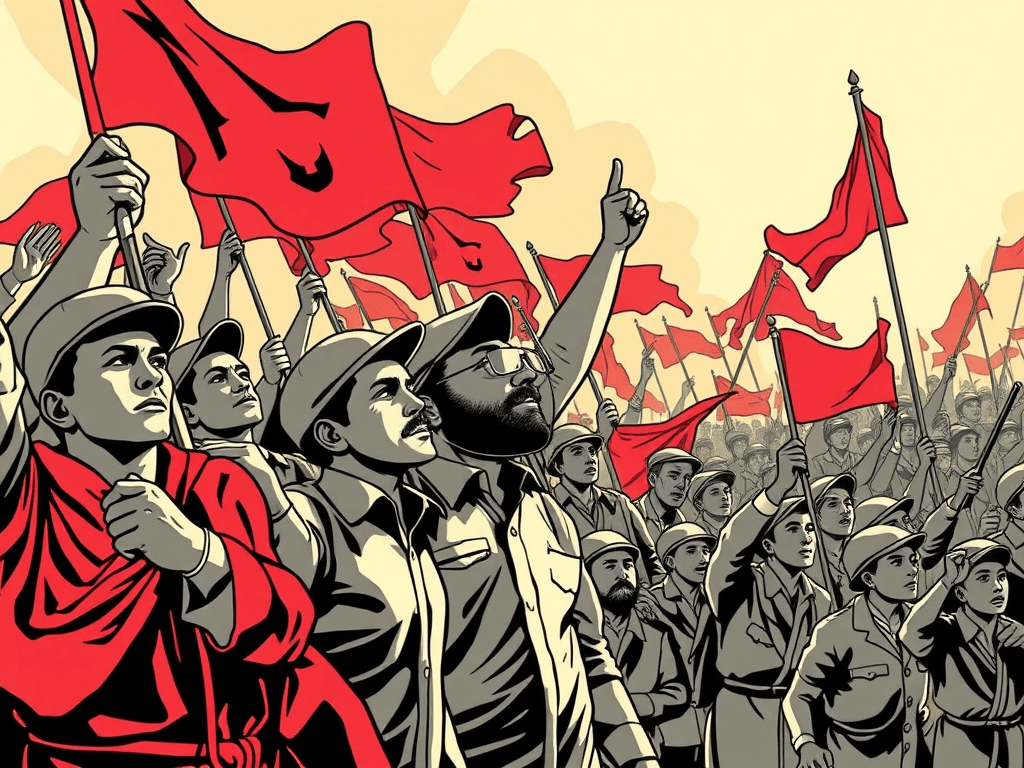
Ted Grant’s Programme of the International presents a foundational framework for revolutionary socialist strategy, emphasizing a clear, practical approach to class struggle. Rejecting opportunism, Grant advocates for democratic workers’ control and critiques capitalism’s impact on consciousness. His insights into socialist movements and internationalism resonate today, inspiring new generations committed to combating exploitation and oppression.
-

Žižek’s How to Read Lacan provides an engaging introduction to Jacques Lacan’s psychoanalytic theory. Through witty and clear explanations, Žižek makes complex ideas accessible, using pop culture examples. He connects Lacan’s theories to broader philosophical contexts, challenging misconceptions and emphasizing their relevance. The book is recommended for both newcomers and those familiar with Lacanian thought.
-

Robert B. Parker’s Pale Kings and Princes offers a thrilling addition to the Spenser series, featuring a principled detective investigating a journalist’s murder linked to the local cocaine trade. With sharp dialogue and engaging characters, Parker captures the tension of small-town life, ensuring a captivating read for detective fiction enthusiasts.
-

Clifford Irving’s FAKE! explores the life of notorious art forger Elmyr de Hory, combining investigative journalism with engaging storytelling. The book delves into forgery techniques, psychological motivations, and the art world’s susceptibility to deception. Rich in detail and dark humor, it’s a captivating read for art lovers and true crime fans alike.
-
Karl Marx’s “A Contribution to the Critique of Political Economy” analyzes capitalist societies’ foundational structures, focusing on commodity production and labor’s role in value creation. This seminal work offers critical insights into how economic systems shape social relations, remaining relevant for those studying economics, sociology, and political science.
 Letters from Tomis