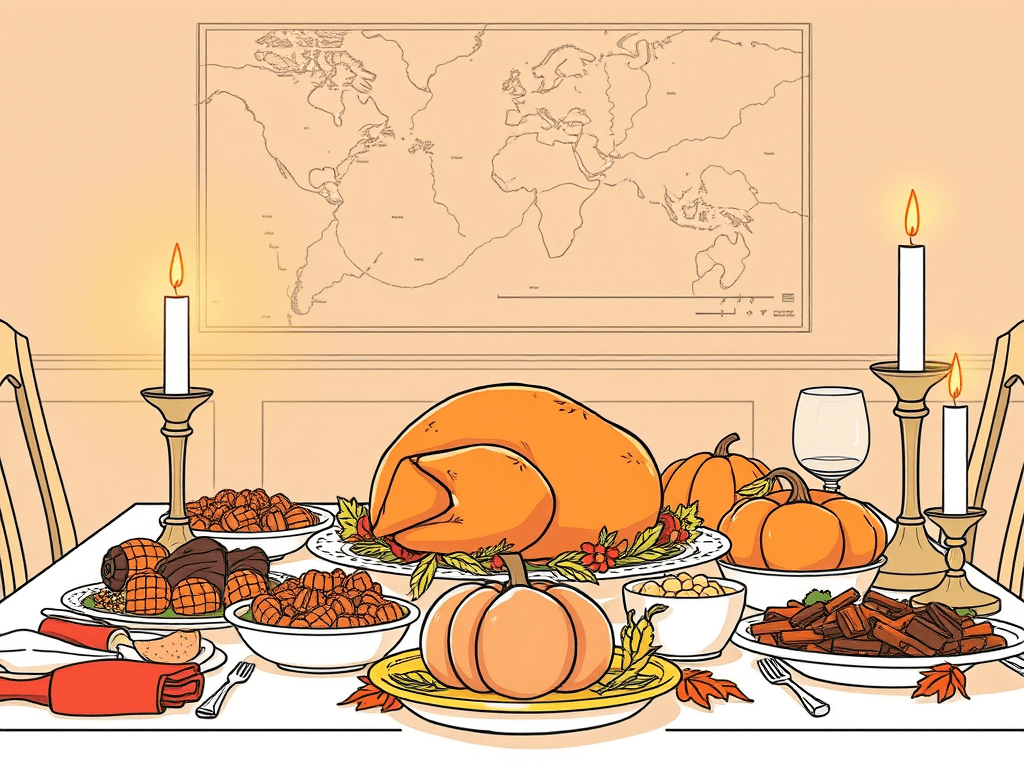
There is a certain charm to Thanksgiving, that most American of holidays, with its peculiar amalgamation of reverence and revelry, its emphasis on family and food, and its paradoxical embrace of both history and myth. It is, at once, a celebration of abundance and a reminder of scarcity—a day for gorging oneself into near oblivion while vaguely nodding to the idea of gratitude, which often recedes into the background like the vegetables on a plate otherwise dominated by turkey, gravy, and pie.
The origins of Thanksgiving, as most schoolchildren are told, revolve around a harmonious feast shared by Pilgrims and Native Americans, a myth so simplistic as to be offensive. If we are to be serious, we must acknowledge that the story, like much else in American history, is a sanitized narrative constructed to placate national vanity. The real history is messier, bloodier, and infinitely more tragic—a tale of conquest, disease, and displacement that does not sit nearly as well with stuffing and cranberry sauce.
Yet, even as we acknowledge the hypocrisy embedded in the holiday’s origins, we might still find value in the act of pausing to express gratitude. To give thanks—whether to a deity, the forces of fortune, or simply the vagaries of life—is, in some sense, to affirm our existence against the vast indifference of the cosmos. It is to recognize, however briefly, that we are here, improbably and fleetingly, and that we owe something—whether to others, to chance, or to the accidents of birth and circumstance.
But let us not be too quick to sanctify this act. Thanksgiving, like much else in modern life, has been commodified and trivialized. It has become less a moment of reflection and more a prelude to the orgy of consumerism that is Black Friday—a day on which gratitude gives way to greed, and the quest for the next shiny object eclipses any lingering thoughts of what we already have.
If there is a lesson to be salvaged from Thanksgiving, it is not found in the myths of Pilgrims and Indians, nor in the gluttonous excess of the modern feast. It is, rather, in the idea that gratitude, properly understood, is not a passive emotion but an active stance. It requires us not only to acknowledge what we have but also to question what others lack and why. It demands that we look beyond the confines of our own tables and consider the broader inequities of the world—a task that is both uncomfortable and necessary.
So let us feast, by all means, but let us also think. Let us acknowledge the contradictions and hypocrisies of Thanksgiving without letting them obscure its potential for meaning. And above all, let us give thanks—not for what we have been told to cherish, but for what we truly value, and for the capacity to discern the difference.
I do wish you all a Happy, thoughtful, Thanksgiving.
 Letters from Tomis
Leave a comment